By Eddie Burkhalter, Appleseed Researcher
At the age of 14, Marvin “Trey” Taylor III found his father’s body. His pharmacist father died of an overdose, his family says. Mr. Taylor struggled for years with addictions afterward, and at the age of 32 was attacked inside Ventress Correctional Facility on Dec. 30, 2025.
Mr. Taylor was taken off of life support and died five days later inside Southeast Health hospital in Dothan, his mother, Jamie Stone, told Appleseed.
“We got there and he had bruises on his face, a cut on his eye. He was in a coma. They did a test the next day and he didn’t have any brainwaves. His brain stem was damaged,” Mrs. Stone said. He was removed from life support and died on Jan. 4, 2026. “He never woke up.”
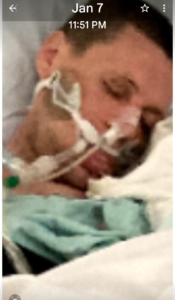
Trey Taylor, following an assault at Ventress prison
Yet despite statements from the prison warden to both the mother and grandmother that Mr. Taylor had been assaulted, and photos taken at the hospital showing black eyes and large bruising across his face, his death certificate, obtained by the family and completed by a physician at Southeast Health in Dothan lists the cause of death as “subdural hematoma” and the manner of death as “Natural Causes.” A subdural hematoma is a type of bleeding near the brain that is most often the result of a head injury. 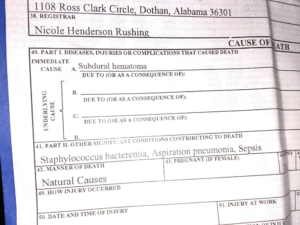
It was unclear on Tuesday why the death certificate lists the manner of death as “Natural Causes” rather than “Homicide.” Attempts to reach the physician whose name appears on the death certificate on Tuesday were unsuccessful, and questions to ADOC on Tuesday about the death certificate were not immediately responded to.
Mr. Taylor’s life took a hard turn when, as a young teenager, he found his father’s body, Mrs. Stone said. Her son spent the subsequent years mostly alone in his room and with few friends. He did enjoy fishing and would often go to a local skating rink on weekends, but eventually methamphetamine took hold of his life, she explained. Instead of removing him from the temptation of drugs, Alabama prisons exposed her son to new, more deadly drugs, including fentanyl, which he struggled with while incarcerated.
Mr. Taylor may be the first homicide victim this year among those incarcerated by the Alabama Department of Corrections (ADOC), a prison system besieged with overdoses, violence and death.
The death toll inside Alabama prisons in 2025 was nearly three times the national average. At least 202 people died inside Alabama prisons in 2025, Alabama Appleseed discovered through a records request to ADOC. Alabama’s prisoner mortality rate in 2025 was 957 deaths per 100,000 people, compared with a national average across state prisons of 330 deaths per 100,000, according to the U.S. Department of Justice Bureau of Justice Statistics.
That was a drop from the 277 deaths in Alabama prisons in 2024, following another slight decline from the record high 327 in 2023. While the decline can be considered progress, the rate of deaths across Alabama prisons dramatically exceeds the death toll in other state prison systems, and continues to be high despite multiple commissions, committees, hearings, lawsuits, and investigative reports.
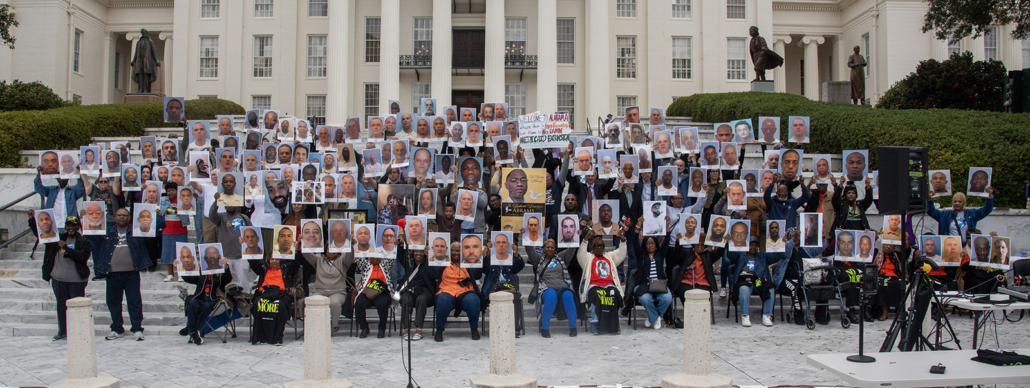
On Ash Wednesday, Alabamians gathered on the Capitol Steps to remember those who died in state prison custody. Photo by Bernard Troncale
Alabama prison’s overdose mortality rate in 2023 was 20 times higher than the national average across all state prisons in 2019, the last year for which the federal government has made that data available. Illicit drugs are most often brought in and sold by Alabama Department of Corrections (ADOC) staff themselves, as publicized arrests and interviews with incarcerated people show, and while ADOC has made increasing efforts in recent months to catch and charge these employees, drugs and the overdose deaths persist. Just last week a woman employed with Yescare, the ADOC’s medical contractor was after a search of her home turned up significant amounts of meth, fentanyl, and other drugs.
Mrs. Stone said the prison’s warden called her on the last day of the year to tell her that he’d been attacked and was in the Dothan hospital. A bracelet on her son’s arm had the date of Dec. 30, so she assumes he was attacked that day. She has gotten little information from the prison, and Appleseed’s attempts to get information on his death from ADOC date back to Jan. 30, and as of March 10 Appleseed has not received a response.
Mrs. Stone believes her son was in debt to other incarcerated men over drugs, which are plentiful inside Alabama’s prisons and drive much of the violence and death. The last time she spoke to her son by phone was on Dec. 30, the day he was attacked. He’d asked for money, she said.
“He used to call every day saying he owed somebody money. He wanted me to put in on another guy’s account, and don’t put it on his, and I knew it was for drugs…so I wouldn’t send him anything,” Mrs. Stone said. “I assume they jumped on him because he owed money, because I’m pretty sure he did.”
Mrs. Stone said another family member about a month prior to his death sent money to pay off a previous drug debt he owed. It’s common for those serving inside Alabama prisons with drug addictions to generate debt to those selling, which often leads to violence and death, according to Appleseed’s tracking of prison deaths and interviews with impacted family members.
As for who attacked her son, Mrs. Stone said she hasn’t been told. “The only thing they told us is that they’ve got in isolation…he’s by himself and that they’re keeping him for his safety, and so that nobody can jump on him, and he can’t hurt anybody else until the investigation is complete,” Mrs. Stone said.
Patricia Blankenship, Mr. Taylor’s grandmother whom he lived with for many years prior to his incarceration, said the warden told her by phone that her son had been hit by another incarcerated man, and that she’s awaiting the results of an autopsy.
Mrs. Blankenship told Appleseed that her grandson struggled after his father’s death. She and her husband tried for years to get her grandson help with his addiction to methamphetamine, she said, and he spent time at an in-patient treatment facility for youth in Mobile, but nothing stuck.
Mr. Taylor in 2018 pleaded guilty to third-degree escape for leaving a court-ordered treatment facility and was sentenced to 20 years in prison, split to serve five of those years in ADOC with three years of probation. He had three prior felony convictions from 2013 connected to his grandmother’s credit card for credit card fraud, possession of a controlled substance and theft of property, which enhanced his sentence under Alabama’s Habitual Felony Offender Act.
Mr. Taylor was later released on probation, but in 2023 was charged with domestic violence harassment and was sentenced to one year in prison on April 30, 2025, and his probation was revoked on the previous escape charge, according to court records. He was denied parole at an Aug. 6, 2025 hearing and was set for another parole consideration in August 2028. He had an expected end of sentence date of Sept. 28, 2038.
Mrs. Blankenship explained that her grandson struggled with addiction and made mistakes as a result, but the state had a responsibility to keep him alive.
“My grandson didn’t deserve to die. He didn’t deserve to die like that. Nobody does. They’re human, and they have families. They’ve got to change to keep these men from getting beaten up and killed,” Mrs. Blankenship said. “One lieutenant told me that they don’t have enough guards because they can’t keep them.”
In 2023, Mr. Taylor even completed ADOC’s 6-month Crime Bill drug treatment class, his grandmother said, and the warden told her he was in some sort of other class at the time of his death, but with so much drugs inside Alabama’s prisons she wonders how effective those classes are.
“I don’t know what good it does, They’ve got more drugs in prison than out here in the street,” Mrs. Blankenship said. She’s heard from others that it’s often the officers who bring in and sell the drugs.
Mr. Blankenship said she prays that Alabama’s lawmakers will do something to prevent more of these deaths. “I hope they do something. I pray they will. They’ve got to do something,” Mrs. Blankenship said. “I miss him so much. It’s hard to image him gone, because it’s hard to accept.”