
By Carla Crowder and Carl Green
Carl Green learned how to provide emergency medical care to his fellow prisoners after they were beaten, stabbed, and cut inside Donaldson prison. Sentenced to life imprisonment without parole for a series of fast food restaurant robberies, Carl served 36 years in prison. No one counted exactly how many lives he saved.
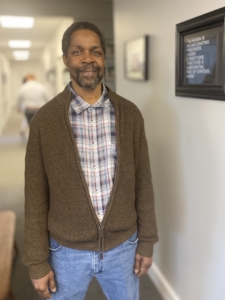
Mr. Green served 36 years in prison before being represented by Appleseed and released.
Carl never expected to be released from prison. Appleseed took on his case several years ago after learning about him from Ronald McKeithen, our Director of Second Chances, who has known Carl since they were teenagers in Birmingham. Both of them came from difficult, impoverished backgrounds and they met in the City Jail. Carl was from New York, where he dropped out of school and went to work to help support his family at age 13, first as a delivery boy for a deli, then as a restaurant bus boy. There were five children in his family and no father figure, so he was committed to helping his mother.
Eventually the family made its way to Alabama. Carl fell into struggles with drugs and alcohol as a young man. By age 30, his felony convictions – none of which involved physical harm of another person – resulted in a mandatory sentence of life without parole. He spent all of it in Donaldson Correctional Facilities, one of the most violent prisons in Alabama.
Carl Green and Appleseed Legal Director Scott Fuqua on release day in 2025.
Beginning in 1993, he began providing medical care to injured incarcerated people, learning from another incarcerated man. Carl estimates that he stitched up between 20 and 25 people with varying degrees of injuries over the years. “Most of the jobs I did was butterfly stitches,” he explained.
Carl walked out of Donaldson prison for the last time in December, thanks to a decision by Jefferson County District Attorney Danny Carr not to oppose resentencing. Presiding Circuit Judge Michael Streety entered an order resentencing Carl Green to time served and finding: “This Court is confident that had petitioner been sentenced according to today’s sentencing standards the imposed sentence could have been dramatically shorter in time.”
Since his release, Carl is frequently in our office, working with Appleseed’s reentry team to develop plans for moving forward with his life at age 65. “I see myself as an old man now and opportunities aren’t as available as when I was young,” he said recently. “I regret the crimes I committed. I wish I could tell my victims how I feel.”
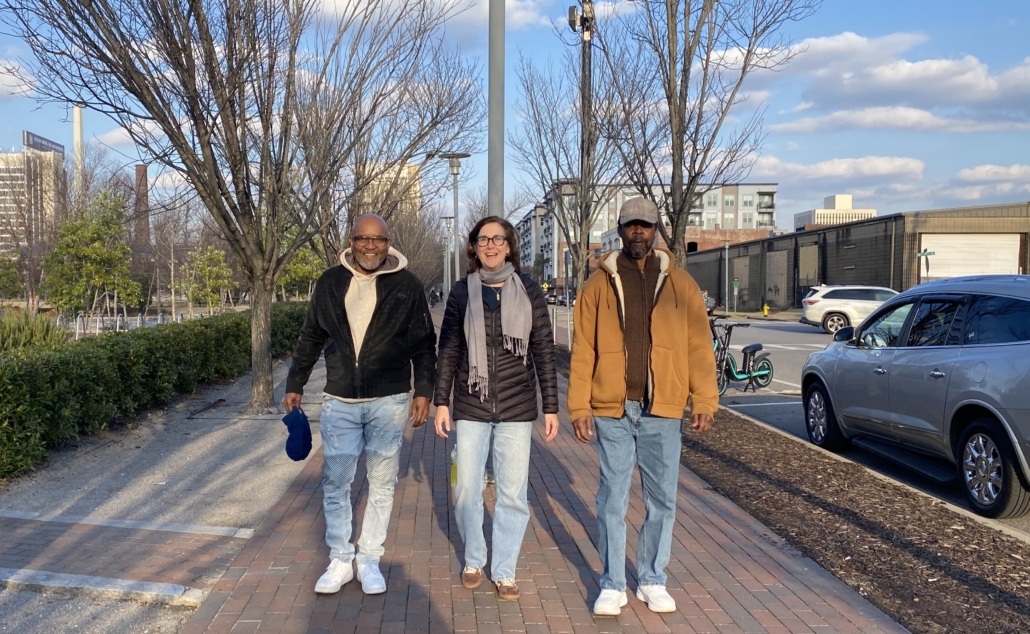
Carl Green, Ronald McKeithen, and Appleseed Executive Director, Carla Crowder, enjoy a walk in Birmingham’s Railroad Park.
We prod him into sharing stories of his medical work in prison, in part because these make-shift heroics seem nearly unbelievable in a cell block setting: bleach for disinfectant, paper clips for needles, guards who knew what he was up to and thanked him. Yet, they became commonplace. So we asked him to write about his efforts so others could know both how horrific the violence is inside our prisons and how generous and determined to help some of the people our state has thrown away have proven to be. Here are a few of his stories in his own words:
Around 1996, the violence had begun to pick up. A drug deal had gone bad within the gang, a package was not delivered on time. So the middle man was beaten and stabbed several times. I was asked to fix him. He was my first patient. He had a busted eye, a busted lip, two stab wounds to the shoulder. Being that he was the first inmate I ever worked on, I only used alcohol pads and just patched up the holes in his shoulder. And gave him some ice for the swelling on his mouth and eye. The big part was negotiating to keep him from being killed.
As the years passed, the gangs became more violent and injuries were more severe. I once had to work on an inmate who had beat another inmate out of $25. He had underestimated the situation and found himself in a world of trouble. This inmate was being held in a cell by two inmates that were killers. He had been sliced in on the neck with a box blade, (similar to a utility knife) all of this for a little of nothing, I thought to myself.
When I entered the cell to examine him I found this man holding a towel to his neck scared to death, eyes full of tears with a towel wrapped around his neck soaked in blood. There was an inmate at the door and another standing behind him. I got a spray bottle of bleach and sprayed the wound which sent him through the roof, oh the pain. When he calmed down I looked at the laceration. Two inches, long, third-degree injury. Barely missed his jugular vein. It was horrible.
I told the inmate with the box blade I can’t fix it. He almost lost his mind. He said if I can’t fix it, he’s a dead man. So I said “Wait, wait let me take another look.” The guy was begging for his life. I said I can fix it. Salt to stop the bleeding, bleach for infection, surgical tape strips for the suture.
A few hours of work, and a madman wanted to bring me another victim while [I was] working [on] the first victim. I said if you do I’m out and you got lockup. He came to his senses. And I finished my job. The two never had another problem. I saw my work a few weeks later, and it seemed I never stopped stitching inmates.
The next inmate got robbed while selling alcohol. He was beaten, stabbed, cut, and skin popped. I had to get another prison doctor to help me. Further he was more experienced and had all the medical supplies I needed. A good friend of mine. We had to check and make sure his lungs weren’t punctured and make sure he was not bleeding internally.
Puncture wound to his back, chest, laceration to face, chest and back, pumpkin head, face swollen, eyes, lips. I cut surgical strips, you suture, I pinch suture, I patch, go. No bubbles in holes and he’s bleeding out. Good, we’ve got 20 minutes before count time. Need a clean up man.
We fixed this guy in 20 minutes. We used Pine Sol, bleach, salt, real needles, and surgical tape strips, pressured his chest by hand, discovered no air in or bubbles in his blood, in the chest or back, and all the puncture wounds were bleeding out which meant we could work on him and didn’t have to send him to the infirmary. That’s prison doctor talk.
The worst, worst wound: an ice pick or a knife pointy as an ice pick. Or a Bone Crusher, or a short dog.
A friend of mine got hit with a short dog in the neck. He had beat a guy out of some drugs earlier in the month. Well, the inmate he beat out of the drugs happened to be a friend of mine as well. I talked to the both of them prior to the stabbing. It was quashed, until the one who stole the drugs started feeling untouchable. Face fights, reckless eyeballing, and a sneaky grin, set the battle in motion. Three on one; the drugs weren’t worth the violent torture. Three maniacs exacting revenge for their stolen drugs. It took every bit of energy to peel them off of him, and just for good measure a couple of shots to the back and shoulder blade on the way out, with the short dog. Three-inch blade, three-inch handle. Usually made from short steel scissors.
The shot in the shoulder blade caused a blood clot, which caused blood to flow to his neck. There was a knot on his neck the size of a baseball. I told him he wouldn’t make it to the infirmary if he didn’t let me get the clot out of his neck. At first he refused, when asked to look at his neck in the mirror and he saw his neck he took a seat and let me work on him. He held his breath while I pressured his chest, after several attempts the blood flowed out the hole in his shoulder blade. A blood clot popped out as big as a quarter. He was soaked in blood and so was the cell.
I negotiated his safe return to his cell and that he be left alone. And to stop the bleeding I used salt which made him hit the ceiling. I fed him for two days. Also, the fact that he had fainted from the strain and the loss of so much blood. He moved to another unit before being fully healed.
These are some of the things that can be made into weapons in prison:
- Metal boxes- knives, hatchets, axes
- Kitchen oven grills- ice picks
- Plexiglass windows- knives, can’t be detected by metal detectors
- Bed rails- Make knives that are considered bone crushers
- Toenail clippers- make box blade, similar to a utility knife, after being filed down
- Locks- put on the end of belt buckles or in socks, used as slings
- Batteries- multiple batteries and a sock used as a sling
- Steel short scissors- broke apart used as a short dog, [for] close-in fights.
These are some of the things that can be made into materials for medical work:
- Paper clips large or small, used as suture needles
- Good for curving: metal wire from brooms or mops. Metal from the arms of eyeglasses, guitar string.
And all of the above you only have to flatten one end and make a hole in it. Now you have a sewing needle. I cannot forget to mention smuggled needles from the laundry.
These are some of the things that can be used as infection preventions:
- Salt- stops bleeding and starts healing process, burns the wound, painful as hell
- Pine Sol
- Bleach
- Sea breeze
Mix any of these, healed overnight.
This is not nearly close to the medical help given. The most important part is being able to negotiate to bring about a peaceful solution to a violent situation. That’s the real reward. In all the years of my work I’ve never charged one inmate. But have accepted a gift or two for my diligence.
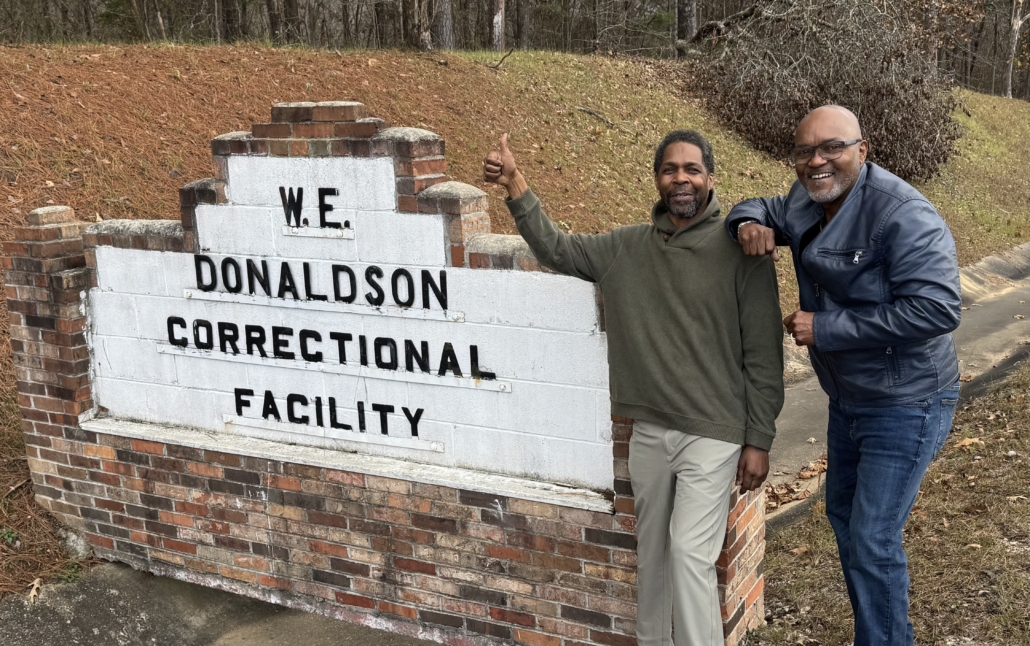
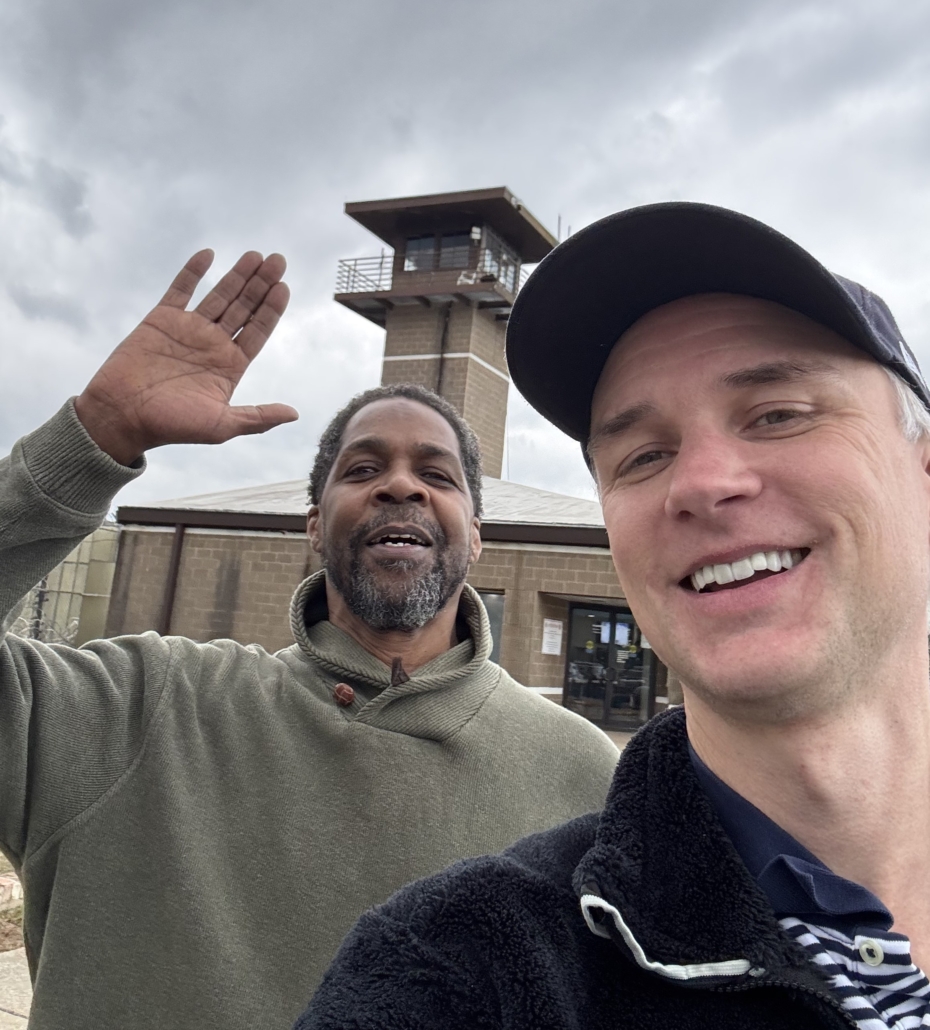
Carl Green and Appleseed’s Ronald McKeithen celebrate Carl’s release. The two have known each other since they were teenagers.




Leave a Reply
Want to join the discussion?Feel free to contribute!