
The good news about crime that you probably won’t hear about in election ads
By Eddie Burkhalter, Appleseed Researcher
In Alabama last year, both violent and property crime fell by a combined 7.5 percent, following a consistent trend of decreasing crime rates across the U.S., according to the Federal Bureau of Investigations crime data analyzed by Appleseed.
Despite frequent public perception that crime is surging, all four violent crimes, defined by the FBI’s Uniform Crime Reporting program as rape, robbery, aggravated assault and homicide, fell in Alabama and across the country last year.
In 2025 violent crimes in Alabama fell by 6.5 percent from 2024, and property crimes (larceny-theft, motor vehicle theft, burglary and arson) fell even further, by 7.8 percent.
Violent crime has not been this low nationwide since 1968, and property crime rates are lower than they have been since pre-1960s, according to an analysis of FBI data by Jeff Asher, a nationally recognized crime data expert and co-founder of the data analytics firm AH Datalytics.
Falling crime has continued to trend across the country, and in Alabama, for many years. Over the decade from 2015 and 2025, violent crime in Alabama fell by a combined 25.7 percent, while property crime dropped by 41 percent.
Alabama’s largest cities
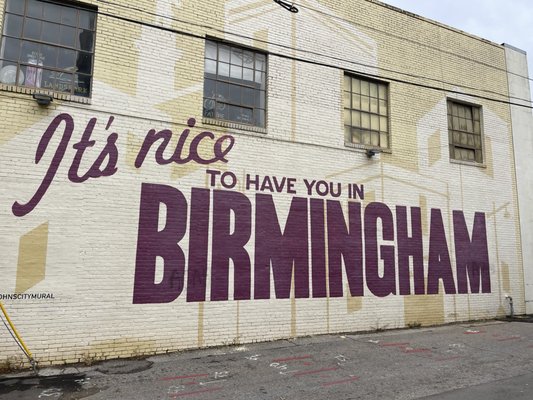
Birmingham is on pace to end 2026 with the lowest number of homicides since 1951, according to AL.com. Between January 1 and June 30, 2026, there were 24 homicides in Birmingham.
“That is a 35 percent decrease over the first half of 2025, which saw 37 slayings at that point in the year and a nearly 70 percent drop for the same time period in 2024,” AL.com reported.
Homicides in Birmingham decreased 43.8 percent last year, according to the Birmingham Police Department’s statistics. Total violent crime in 2025 decreased 5.6 percent, while property crimes increased overall by 3.6 percent, largely due to an 11.5 percent increase in thefts that offset the 19.6 percent drop in auto thefts.

Birmingham Police Chief Michael Pickett, who has overseen a historic drop in homicide in the city.
It was much the same in the city of Mobile, which saw a 16 percent decrease in homicides in 2025, a 32 percent decrease in sex offenses and a combined 11 percent decrease in robbery and aggravated assaults, according to the Mobile Police Department’s (MPD) crime statistics report. Overall crime in the city fell by 11 percent in 2025.
The falling crime in Mobile last year isn’t an anomaly. It’s been steadily dropping there for years as well.
“When reviewing the 10-year comparison (2016-2025) it shows a steady reduction in Part 1 Crimes over the last eight years. We are pleased to report that in 2025; Part 1 Crimes were down -52% compared to ten years ago,” the MPD report states.
Huntsville saw similar reductions in crime numbers last year.
“From 2024 to 2025, violent crime dropped 18.3%, and total reported crime fell 5.8% – a decline from 14,583 offenses in 2024 to 13,725 last year,” Huntsville Police Department’s annual 2025 report reads.
Crime drops, along with incarceration
Politicians love to use crime to scare people into voting for them. And this election cycle is no different. But it’s much easier to scare people than to keep them safe. To understand, and hopefully maintain, these important declines, Alabama policymakers should pay as close attention to what’s driving the good crime news as they do when a tragic crime grabs headlines and motivates them into sudden action.
No one who is serious about analyzing and understanding crime rates will point to a single cause. It is a complex issue driven by factors as diverse as economics, demographics, and policing.
What we do know is that jamming more people into prisons for long sentences has not caused the drop. And we know this because over the last decade the state’s prison population saw a notable drop, right along with the drop in reported crime, showing the downward crime trend can’t be linked to longer prison sentences or increased incarceration rates.
Here’s what happened:
In 2014, Alabama faced mounting pressure to deal with a prison system busting at the seams. With prisons at 195 percent capacity and two lawsuits pending, state leaders were aware that Alabama could be forced to release a number of incarcerated people, just as happened in California with the landmark Brown v. Plata case, where the Supreme Court ruling ordered the release of 30,000 incarcerated people over two years.
Instead, a prison reform task force was formed. The task force included the Chief Justice of the Supreme Court, several District Attorneys and the corrections commissioner. They partnered with The Council of State Governments Justice Center (CSG) which resulted in the passage of legislation, aiming to “strengthen community-based supervision, divert people convicted of the lowest-level drug and property offenses from prison to Community Corrections Programs (CCPs), and ensure supervision for everyone upon release from prison to reduce recidivism.”
In addition, beginning in 2006, the Alabama Sentencing Commission developed and implemented the use of Sentencing Standards to create more consistency and fairness in sentencing practices, and to give judges more options outside of incarceration for lower level felonies.
“In 2012, Alabama’s incarceration rate was the third highest in the U.S., with 650 sentenced individuals per 100,000 adult residents,” a 2014 CSG report reads. Since then, Alabama has consistently dropped to around the 11th or 12th highest incarceration rate in the U.S., closer to Ohio than national leader Mississippi.
So what is causing the drop in crime across the country and here in Alabama?
Experts warn against placing the cause on any particular factor. However, John Roman, director of the Center on Public Safety at NORC at the University of Chicago, in a recent interview with crime stats expert Jeff Asher, explained the many factors that he thinks resulted in a spike in homicides during the early months of the COVD-19 pandemic. His explanation includes a rash of first-time gun owners who had their guns stolen and later used in shootings, but Roman says the overall downward crime trend is more complicated.
While many police departments and local governments point to new policing tactics and newly formed task forces as the cause, Mr. Roman cautions against this. He notes that while changes in policing can have an impact, the crime drop is happening everywhere, in rural and urban areas, in red states and blue states across the country.
“It’s happening all at once. The cause must be national,” Mr. Roman states.
Billions in federal COVID-19 relief funds paid to boost staff in education and social service organizations, behavioral health services, jobs that can prevent young people from committing crimes in the first place, likely had an impact on the drop, among many other factors, he explained.
Getting the public to believe the data shows crime is dropping in the first place is a difficult task, Mr. Roman explained.
“I think there are people whose politics are their identity, and they’re never going to be moved off a position and that happens on both the left and the right,” Roman says. “But I think that for the vast majority of the public, if you give them timely data that is well explained, I think you can change people’s minds.”

Sen. Greg Albritton, who sits on the Alabama Corrections Institution Finance Authority, which just approved a $195 million bond sale to bring the total cost of a new prison in his district to almost $900 million.
The latest and best available crime data is very clear; crime is dropping in Alabama and nationally. It’s up to Alabamians and their lawmakers to consider what that means. Is investing $5 billion over five years into a failing prison system, more than $1.2 billion for a single new mega prison, another $900 million for a second new prison, and more than $80 million to a single attorney and his staff to defend the indefensible, the answer to the state’s deadly prison crisis?
We think there are better ways to invest that money that would not only create safer prisons, but safer communities outside of the fences. Let’s take advantage of falling crime and invest instead in programs and services that improve lives and increase public safety.




Leave a Reply
Want to join the discussion?Feel free to contribute!