
What’s next for safety and justice in Alabama? These leaders share big ideas at Justice and the Next 250 event.
By Eddie Burkhalter, Appleseed Researcher
Alabama’s ongoing prison crisis has been well-documented, and Alabama Appleseed has added to that work, but what would happen if we asked ourselves, what are we building next to address safety and justice?
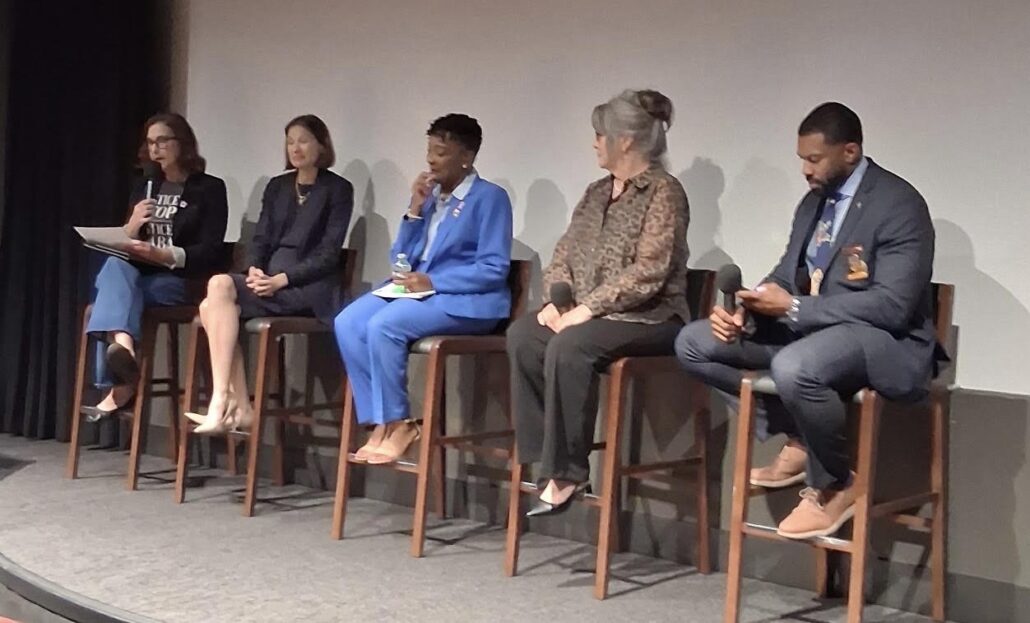
Alabama criminal justice leaders join a conversation about safety and accountability for the future as part of Appleseed’s Justice and the Next 250 events.
That question was central in a discussion Wednesday, the first day of two in the “Justice in the Next 250 in Alabama” series. The discussion followed a viewing at the Sidewalk Film Center + Cinema in Birmingham of a 45-minute extended trailer screening of the upcoming 4-part PBS docuseries Crime and Punishment in America by Lynn Novick and Ken Burns, which is scheduled to air on Alabama Public Television beginning November 16th.
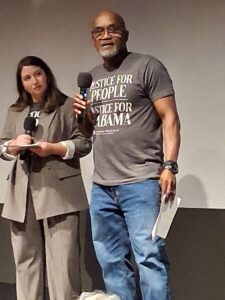
Appleseed’s Elaine Burdeshaw and Ronald McKeithen invite guests to dream big about the future of safety and justice.
This week’s events are a partnership between Alabama Appleseed, Just Trust, Sidewalk Film and Alabama Public Television. Just Trust, a philanthropic fundraising, advising and grantmaking criminal justice reform nonprofit, is funding other nonprofits to host similar Justice in the Next 250 events across the country to coincide with the country’s 250th anniversary.
After the film, Appleseed hosted a conversation about what Alabama’s criminal justice system could look like over the next 250 years. Appleseed’s Executive Director Carla Crowder asked leaders in criminal justice and law enforcement questions about innovative new strategies or technology the speakers were implementing that would have been unheard of a decade before, what they’d like to see in the future and how their efforts seek to level the playing field for those who don’t have the financial resources to navigate the criminal justice system.
Birmingham Police Chief Michael Pickett, who heads the department during what has been an historic drop in crime in the city, explained that the department has dedicated officers who have the “soft skills” needed to understand the needs of the unhoused population in the city.
“I’ve been in law enforcement for 22 years. We did not have officers assigned to help address the issues with the unhoused community,” Chief Pickett said. “It’s not a crime to be unhoused. It’s not a crime to have a mental health issue or have a mental health breakdown, but sometimes it leads to criminal activity…and sometimes it lands on law enforcement, so we recognize we have to have other tools to properly address it.”
Birmingham homicides so far this year are down by 44 percent from 2025, and 74 percent down from 2024, Chief Pickett said. Overall crime is down 13 percent from last year, he said.
“That is huge,” he said, and he puts much of that reduction in homicides to the targeted arrests of several people whom he said were involved in murder-for-hire plots between a few groups.
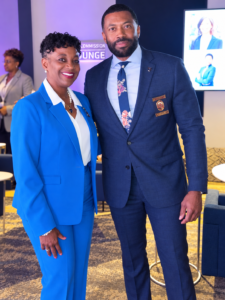
Bessemer District Attorney Lynneice Washington and Birmingham Police Chief Michael Pickett shared creative approaches to law enforcement that have made the region safer.
Bessemer District Attorney Lynneice Washington created Alabama’s first Conviction Integrity Unit, and spoke about her “Second Chance Hiring Fair” which began by helping those recently released from prison get jobs, but has since expanded to include the public.
“It’s important to me to be more proactive than reactive,” Mrs. Washington said.
Speaking of her Conviction Integrity Unit, Mrs. Washington said it began in 2017 after she saw a similar unit in Chicago had freed many people from prison who were wrongfully convicted and who didn’t have the resources to navigate the criminal justice system.
“It’s a lack of money. It’s a lack of education. That is why they are in prison,” Mrs. Washington said. She spoke about her unit’s work to get the release of Irvin Harris, who was exonerated in June after serving 42 years for a 1974 rape that he did not commit.
Montgomery Circuit Court Judge Brooke Reid oversees a specialized mental health court, and said that in recent years Alabama’s Administrative Office of Courts placed all such courts, including drug court and mental health court under the umbrella of accountability courts, which are having a positive impact on crime reduction.
“I think ten years ago versus today, I think accountability courts were not as widely accepted as being a solution I think to recidivism,” Judge Reid said. We now have evidence-based research that by combining treatment with accountability, reduces recidivism, she explained.
Of those who graduate from drug courts, 75 percent don’t come back into the criminal justice system, Judge Reid said, while about 75 percent of those who do not graduate do re-enter the system.
Cheryl Maddox, director of Chilton County Community Corrections, heads a program that diverts people from prison into community-based treatment, said her agency works to keep people from entering prison by facilitating mental health and substance abuse treatment and supervision. “I’ve become an advocate for working with mental health….And we don’t turn down anyone,” Mrs. Maddox said. She lifted up the desperate need for more low-income housing and transportation in rural Alabama as a bridge to safety and reduced crime.
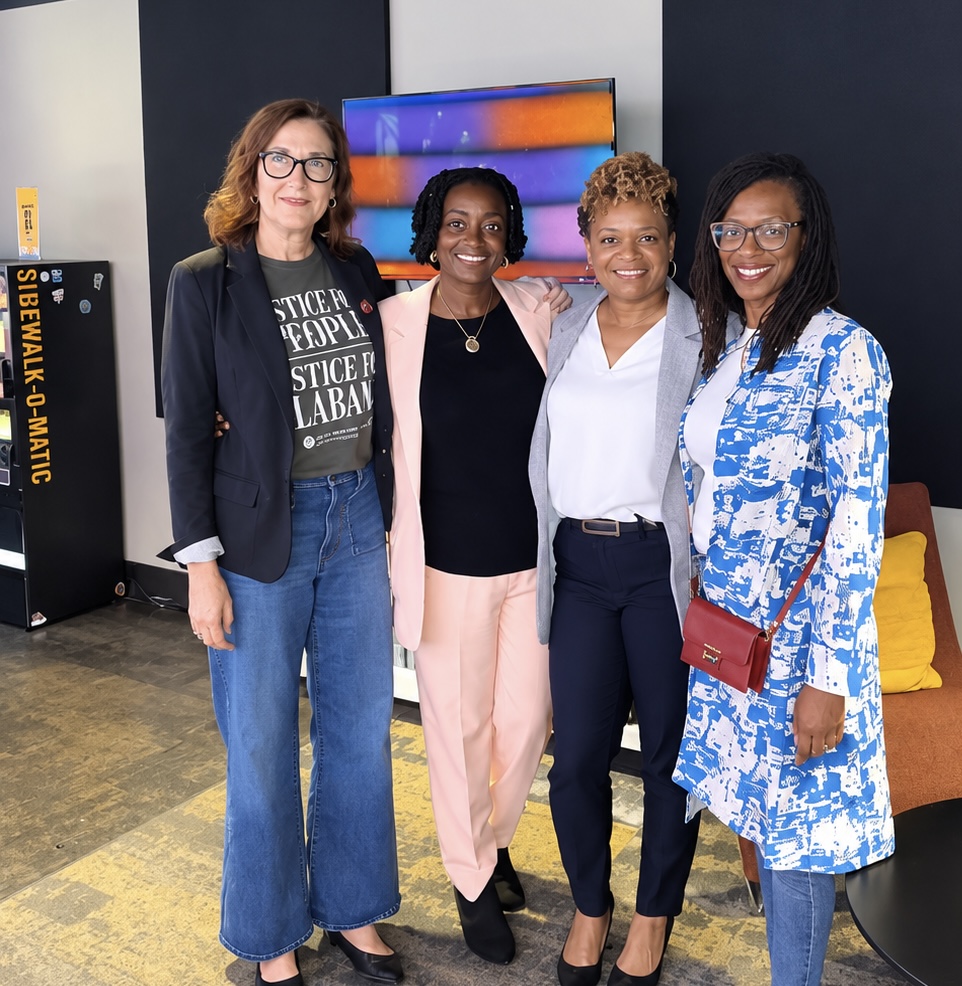
Advocates joined Gigi Hayes, a candidate for Alabama House District 52 at the event.
The second night of Appleseed’s Justice in the Next 250 event will take place Thursday, Oct. 8th beginning at 6 p.m. and will feature the award-winning documentary Leaving Angola, which follows Justin Singleton, a man serving life without parole, and Derek Moss, a young father who receives early release through a pioneering re-entry program at Louisiana’s Angola prison.
The discussion following the film will include speakers Ron McKeithen, Appleseed’s director of Second Chances, and Justin Singleton, from the documentary Leaving Angola.


Leave a Reply
Want to join the discussion?Feel free to contribute!