
By Carla Crowder, Executive Director

Carla.Crowder@alabamaappleseed.org

One year ago, Alvin Kennard stood in a Bessemer courtroom nervous and uncertain. Striped jailhouse scrubs swallowed his rail-thin, shivering frame. After 36 years in a sweltering, unairconditioned prison, the chilled air of Judge David Carpenter’s courtroom was a shock to his system.

What came next was a shock to the justice system.  In 1983, Mr. Kennard had been sentenced to life without parole for a $50 robbery at a bakery. Judge Carpenter scrapped that and resentenced him to time served. A courtroom filled with Mr. Kennard’s friends and family erupted in hallelujahs. The television cameras started rolling.  As his attorney, and a worrier by nature, I immediately started thinking about next steps: This 58-year-old man had been incarcerated nearly two-thirds of his life. How on earth was he going to adjust to the outside world?

Extremely well, it turned out. Alvin Kennard filed a tax return this year. He tithes at church. He hasn’t even been affected by Covid-19, other than limits on the family gatherings he loves.
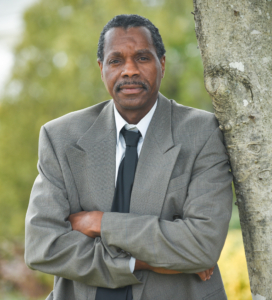
Alvin Kennard outside his home in Bessemer. August 28 marks the year anniversary of his freedom from a sentence of Life Without Parole for a $50 robbery. By Bernard Troncale

Mr. Kennard’s large, supportive family was critical to his successful re-entry. A room was ready in his brother’s home. A niece, who is a Bessemer businessowner, helped with transportation. Church connections helped him secure employment within six weeks at Town and Country Ford, where he works in the body shop buffing cars. Every so often, he calls me on his lunch break and lets me know things are still going just fine.  During the holidays, he texted me photos of him at the staff holiday party, standing next to a huge inflatable polar bear. Imagine returning from Alabama’s hellish prisons to a world where holidays are filled with enormous glowing inflatables. Mr. Kennard embraces it all – with joy.

“It’s almost a year I’ve had my job,” he remarked recently. “It’s been a blessing, it’s been wonderful. It’s not about how much money I’m making, it’s about what God allowed me to do.”

He loves listening to the birds chatter in the mornings, wandering down to the creek of his childhood and watching turtles and snakes. He’s got a favorite meat-and-three restaurant, Kayla’s, that’s helped him put on much-needed weight.
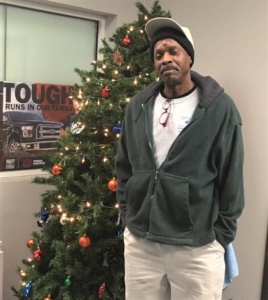
Mr. Kennard at work over the holidays. He’s employed in the body shop at a Ford dealership in Bessemer.


All conversations with Alvin Kennard eventually lead toward God. No matter how hard I try to give him credit for how hard he worked, how much he suffered, how he deserves a good life, he invokes God and the conversation becomes a prayer.

I wish more Alabama legislators, judges, and prosecutors could pray with Mr. Kennard.

Until last year, he was labeled a “violent felon” based on his robbery conviction at age 22.  Because of three minor non-violent convictions stemming from the same arrest at age 18, he was labeled a habitual offender.  Based on the calls and mail that poured into Alabama Appleseed’s office following news of Mr. Kennard’s freedom, there is a world out there that does not see him as a violent felon.  “A few month ago, I heard about you. My father was from Alabama, Bessemer, too,” wrote Elizabeth, from Spokane, Washington, who mailed him a little cash – “a gift, so that your days moving forward are hopeful, full of love and belonging.”

Elizabeth acknowledged something else about Mr. Kennard’s story: “I’m learning more about how horrible the police and jail systems are (& the laws, too). It’s not new … but the depth of the corrupt mission is being seen.”

At Appleseed, we’ve also gotten mail from those still stranded in prison honor dorms. Men in their 60s, 70s, one who is 86, sentenced to die in prison for the sins of their youth under Alabama’s draconian Habitual Felony Offender Law. They tell us about their kidney problems, their high blood pressure, their crack-cocaine addictions from the 1980s that led to convenience-store hold ups and courthouse decisions that they were forever beyond redemption. Except now, they are the prisons’ hospice workers, GED teachers, barbers, launderers, preachers, peacemakers, and clean-up crew.  “The [whole] time I’ve been in, I’ve worked as a hall runner, shift office runner, infirmary runner and have seen so much brutal violence and had to clean up so much blood out of cells, off of walls and hallways and had to help pick up dead inmates or seem dead and get them to the infirmary,” wrote one man whose conviction dates back to the first Bush Presidency. “I’ve had so much prison blood on my hands, I see it in my sleep.”

Due to the limitations and complexities of Alabama criminal procedure, there is currently no clear vehicle for second chances for these old men in the honor dorms.  Mr. Kennard is free only through extraordinary mercy and grace from Judge Carpenter and the Bessemer Cutoff District Attorney’s Office led by Lynneice Washington.

Mr. Kennard in court on the day he was resentenced.

Mr. Kennard turns 60 this year. He will celebrate a full year of employment and get a week’s paid vacation. Most likely he’ll purchase a new suit or two. If there’s one thing I’ve learned about Mr. Kennard this year – beyond his faith and his work ethic – is that he is a sharp dresser, which makes it all the more unfortunate that the cameras were rolling on him while he wore faded jailhouse scrubs.

He is much more himself in his Sunday best.

Alvin Kennard rarely speaks of his freedom without acknowledging his faith in God. By Bernard Troncale

 

By Carla Crowder, Appleseed Executive Director

Birmingham, Ala. — A little more justice slowly made its way into Alabama this week.

Roberto Cruz, a 71-year-old man who had been sentenced to die in prison for a case involving marijuana – that’s right, only marijuana – was resentenced to time served and will soon be released from Donaldson prison.

Mr. Cruz’s odyssey through the Alabama court system contains so many remarkable elements it’s hard to know where to start. In 2003, he was charged with drug trafficking when the vehicle he was a passenger in was pulled over in Warrior and police found 25 pounds of marijuana in the trunk.  The driver received a 3-year split sentence and was deported.  Mr. Cruz was sentenced to Life Without Parole.

Roberto Cruz was ensnared in a system that has some of the country’s harshest sentences and lowest weight thresholds for marijuana offenses, Jefferson County Judge Stephen Wallace found, when he resentenced Mr. Cruz to time served.

The State’s primary evidence, according to Jefferson County Circuit Judge Stephen Wallace’s order: “[C]ircumstantial evidence suggesting that since the defendant was a passenger in the vehicle and marijuana has a strong odor, then he must have known about the drugs.”

At trial in 2005, Mr. Cruz’s attorney offered no mitigating evidence nor objection to the State’s use of prior convictions from 1985 to enhance his sentence under the Habitual Felony Offender Act. It took almost 16 years for the Alabama justice system to correct this error. Turns out, the State was not permitted to use those old convictions, all of which were drug crimes stemming from a single incident in Georgia.  Well-established Alabama case law excludes drug convictions prior to 1987 for use in HFOA sentencing because drug crimes had their own recidivist statute until then. But no one in Judge Gloria Bahakel’s Jefferson County courtroom 15 years ago could be bothered to point that out.

The story of how this error got corrected speaks volumes about the frailties in Alabama’s justice system and the harm done to defendants without access to money. The Alabama Court of Criminal Appeals affirmed the conviction and sentence.  Incarcerated and without the benefit of counsel, Mr. Cruz filed post-conviction petitions that went nowhere. Then investigators with the Southern Poverty Law Center discovered his case while researching marijuana trafficking cases. They put Mr. Cruz’s plight on the radar of Jefferson County Public Defender Adam Danneman, who vigorously took on the case.

Judge Wallace’s order, most importantly, provides immediate release to a 71-year-old man who has no business at Donaldson prison. But it goes further in pointing out the “disturbing” reality that Alabama is still sending people to prison forever for marijuana, a substance legal in 11 states, and decriminalized in 16 more. “Commercial distribution of cannabis is allowed in all jurisdictions where it has been legalized, except for Vermont and the District of Columbia,” he wrote.  Even in the surrounding southern states of Georgia, Florida, and Tennessee, Alabama’s weight threshold for a trafficking conviction – greater than 2.2 pounds – is way out of line.

“Judge Wallace’s order hits the nail on the head. We have the lowest thresholds and the harshest punishments in the country for marijuana in this state,” Mr. Danneman told me. “Regardless of how you feel about the legalization/decriminalization of weed, 15 plus years in prison is a shockingly harsh punishment. I’m glad we were able to do something about it.”

Appleseed and the Southern Poverty Law Center focused on Alabama’s harsh marijuana laws in our report, Alabama’s War on Marijuana: Accessing the Fiscal and Human Toll of Criminalization. We found that marijuana enforcement costs Alabama taxpayers $22 million per year, a cost worth examining given the enormous state budget shortfalls anticipated by the COVID-related economic downturn and court closures.

The human costs are much worse.

In leaving prison as an older person once sentenced to die there, Mr. Cruz is in good company.  Within the last year, 72-year-old Geneva Cooley and 58-year-old Alvin Kennard have walked free, in large part because of Jefferson County judges and prosecutors who were unafraid to take a second look at how the mistakes of our past are wasting lives and hurting people.  Like Mr. Cruz, Ms. Cooley’s LWOP sentence was for drug trafficking.

Mr. Kennard at his Bessemer home a few months after his release from prison. Photo by Bernard Troncale

Mr. Kennard was my client and I still see him on a regular basis. Within 6 weeks of release, he secured a job at a car dealership. He talks about going to work like it’s the best thing that ever happened to him. Work, family, and church are his priorities.  In fact, Mr. Kennard and Bessemer District Attorney Lynniece Washington attend the same church. And she is fine with that, she once told me. After all, she saw no purpose in opposing Mr. Kennard’s resentencing. He had served 36 years for a $50 robbery.

But there are so many more like them. According to data from the Alabama Sentencing Commission that Judge Wallace included in his order, 22 people in Alabama are serving sentences of Life Without Parole for drug convictions, 255 for robbery – all crimes that require no physical injury for a conviction.  But under Alabama’s Habitual Felony Offender Act, that does not matter.

More than 100 of these people are over 60 years old. As COVID-19 spreads through the Alabama Department of Corrections, with now 25 confirmed cases among staff and incarcerated people, the potential consequences of these sentencing decisions become more fraught.

We celebrate with Roberto Cruz. And still we search for the ways Alabama’s criminal punishment system will somehow provide justice to the many others like him.

For a full account of Mr. Cruz’s case, please read Kathryn Casteel’s detailed report from the Southern Poverty Law Center.