
Other states settle cases, Alabama writes big checks. New contracts will bring total ADOC legal spending for attorney William Lunsford to $86 million
By Eddie Burkhalter, Appleseed Researcher
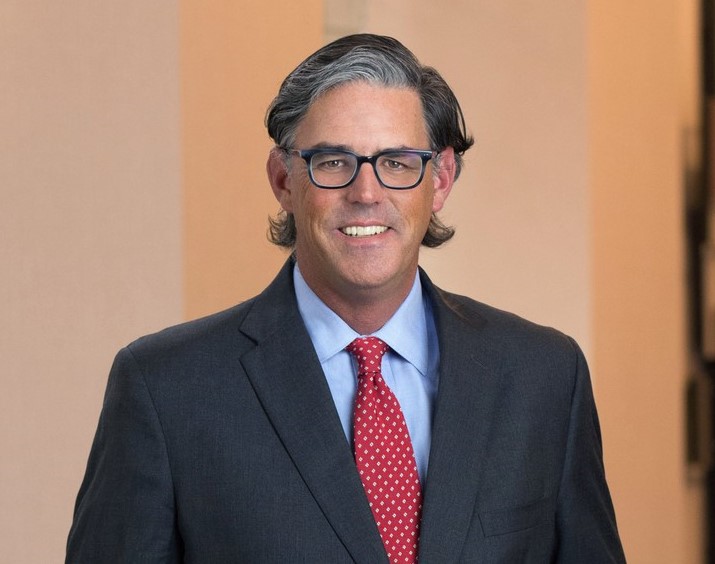
The private Alabama attorney William “Bill” Lunsford, individually and in his role as an appointed state Deputy Attorney General, has been paid $48.8 million defending the Alabama Department of Corrections (ADOC) as of Aug. 5, and millions more of our tax dollars are headed his way.

Huntsville Attorney William Lunsford
That staggering number, taxpayer funds paid to defend the state’s deadly, chaotic prisons, will skyrocket to $86.8 million if the latest contract increase request of $38 million by ADOC goes through as expected. Most of the new money is for an anticipated trial in the slow-moving DOJ case. Appleseed confirmed these totals through state records.
It’s hard to imagine Alabama could prevail in a trial where the U.S. Department of Justice is expected to lay out a case that federal attorneys have been building since 2019, when the DOJ first issued an initial report detailing the widespread, horrifying abuses inside Alabama’s prisons for men. The DOJ filed suit in December 2020. Since then, the state has completely failed to curtail the violence, death, and corruption at the heart of the lawsuit, instead overseeing years of record deaths totaling more than 1,300 since the case began. Many of those facts are also on full display in the documentary The Alabama Solution, which uses cell phone footage from inside Alabama prisons to show rampant violence, deadly force by officers, open-air drug use and a system in chaos. The trial is set for November.
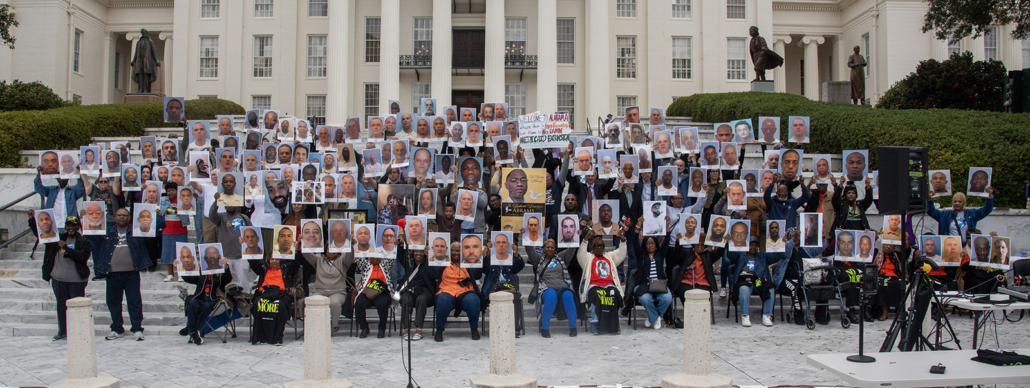
On Ash Wednesday, Alabamians gathered on the Capitol Steps to remember those who died in state prison custody. Photo by Bernard Troncale
Across the country, few states have let lawsuits over conditions much less troubling go all the way to trial. Instead, state officials agree to bring those prison systems into line, working with federal officials and the courts on settlement agreements that are enforced by monitors. Alabama is an outlier when it comes to dragging these cases on, and one has to question what the state gains in doing so.
It’s hard to question, however, whether Lunsford stands to gain by pushing towards a trial, instead of a settlement, because the many tens of millions in tax dollars going to him seem to speak louder than the voices of those who argue the money could be better spent actually trying to solve the myriad systemic issues inside Alabama’s deadly prisons.
Comparing the legal costs with other state spending on lawyers in Alabama makes the Lunsford contracts even more alarming. His current and anticipated payments could fund the salaries of every District Attorney in the State of Alabama for at least nine years, according to recent state General Fund budget documents. The Lunsford contract amounts could also fund the entire Alabama Attorney General’s Office, which employs about 80, for six years.
In a state that purportedly prides itself on fiscal conservatism, only one Alabama lawmaker has questioned the legal spending. Rep. Chris England, D-Tuscaloosa, has temporarily held up the two new contracts for Lunsford to defend the ADOC against the federal government’s lawsuit.
Rep. England, a member of the state Legislature’s Contract Review Committee and the Joint Prison Oversight Committee, put a 45-day hold – all he’s legally allowed to do – on a $30 million contract to Lunsford to pay for litigating the DOJ’s lawsuit over prisons for men, and another $3 million to Lunsford for his legal work on the longrunning Braggs v. Dunn lawsuit over mental health treatment inside state prisons.
ADOC’s request Thursday would push the total spent to defend the department in Braggs v. Dunn to $14.2 million. Legal spending in Braggs has not been a good investment. In June, the Eleventh Circuit Court of Appeals upheld U.S. District Judge Myron Thompson’s findings of deliberate indifference at the institutional level, concluding that ADOC’s mental healthcare was “horrendously inadequate.” The Eleventh Circuit ruled that the prison system violated the constitutional rights of thousands of incarcerated people with severe mental health conditions by showing deliberate indifference to their mental healthcare needs.
In a candid conversation with Appleseed the former director of another state’s department of corrections explained that it makes no sense for a state to place the majority of its prison litigation with one private attorney, whose business is centered on prison litigation, because it incentivises that attorney to drag the case out and continue billing those legal hours instead of finding ways to help solve the crisis and save the state money.
A question worth asking is, if most DOJ lawsuits over prisons ended in either consent decrees or settlement agreements, what has Alabama gained by dragging out this legal fight?
Other states settle and address the problems, Alabama write checks to private lawyers
The Civil Rights of Institutionalized Persons Act (CRIPA) of 1980 is a federal law meant to protect people incarcerated in state and local prisons and jails, those in nursing homes, mental health facilities and other group settings. The DOJ’s 2020 CRIPA lawsuit against Alabama is one of many the federal government has filed since the law’s inception, but one of very few that appears to be headed all the way to trial.
In these matters, the DOJ generally issues a findings letter to states documenting civil rights abuses in prisons and jails, as it did to Alabama in 2019, and if the federal government isn’t able to secure an agreed upon resolution, the DOJ can file a lawsuit, as it did over Alabama’s prisons for men.
In most of those other states where a lawsuit is filed, the cases are adjudicated through settlement agreements or consent decrees prior to going to trial, where the outcomes are uncertain, the costs to states in legal fees can be exorbitant, and the abuses persist as the cases drag out.
Among the many examples of cases settling without trials:
In 1996 the DOJ filed four CRIPA complaints – with Kentucky, Tennessee, Mississippi and Florida – and all four were later settled.
In 1997 there were six new CRIPA complaints filed, and four of those six ended in settlements.
All four of the DOJ’s CRIPA complaints filed in 1998 were settled, and the following year, in 1999, the DOJ filed seven new CRIPA complaints and all seven later ended in settlements before going to trial.
The DOJ’s investigation in 1998 found that staff at five county jails in Phoenix, Arizona “used excessive physical force and restraints in violation of the constitutional rights of individuals detained in the jails.” Arizona and the DOJ entered into a settlement agreement that required the jails to increase staffing and better train staff in the use of force.
Similarly, all three CRIPA lawsuits filed by the DOJ in 2000 settled prior to trials, and another two new CRIPA lawsuits filed in 2001 also settled.
More recently, Massachusetts Department of Corrections settled with the DOJ in 2022 over mental health care and suicide prevention. The DOJ’s investigation found “unconstitutional conditions and circumstances where incarcerated people in mental health crisis harmed themselves up to and including suicide…The department found that MDOC did not adequately supervise individuals in mental health crisis, did not provide them adequate mental health care, and used prolonged mental health watches under restrictive housing conditions.”
Settlements have continued in recent years. In 2023 the DOJ entered into a consent decree with the Minnesota Department of Corrections over what the federal government said was disability discrimination throughout the prison system. Virginia in 2019 settled a DOJ lawsuit over religious practices inside Virginia Department of Corrections prisons. The New Jersey Department of Corrections in 2022 signed onto a consent decree with the DOJ over allegations of sexual abuse, excessive force and retaliation at a prison for women.
Mississippi lawmaker: “We don’t want to be in a situation like Alabama.”
The DOJ in 2020 opened an investigation into four prisons operated by the Mississippi Department of Corrections, including Mississippi State Penitentiary (Parchman), Southern Mississippi Correctional Institute, Central Mississippi Correctional Facility, and the Wilkinson County Correctional Facility, and four years later released a 60-page report that mirrors many of the findings in Alabama’s case, and states that “MDOC routinely violates the constitutional rights of people incarcerated at all three facilities by failing to protect them from widespread physical violence.”
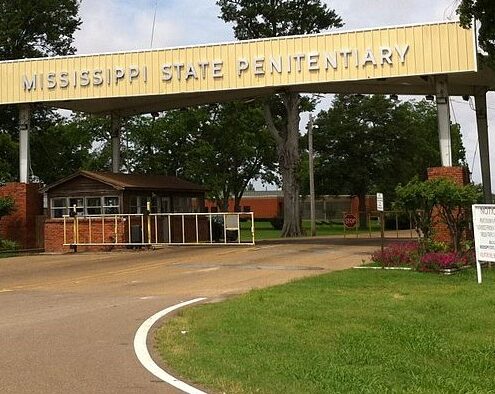
Parchman Prison in Mississippi. Unlike Alabama, Mississippi has avoided a DOJ lawsuit over prison conditions.
“The state does not adequately supervise the incarcerated population, control the flow of contraband, adequately investigate incidents of serious harm, or provide adequate living conditions. These problems are exacerbated by chronic understaffing that has allowed gangs to exert improper influence inside the prisons,” the DOJ’s report on Mississippi’s prisons reads.
It’s been six years since the DOJ opened the investigation into Mississippi’s prisons, and two years since the release of the report, and the DOJ hasn’t filed a lawsuit, as it did just two years after filing its first report on Alabama prisons.
Instead, Mississippi Governor Tate Reeves hired Burl Cain, former head of the Louisiana State Penitentiary at Angola, to lead the state’s prison system and enact reforms.
Cain, a controversial prison leader who opponents say overused solitary confinement and who faced allegations of a land deal with the family of an incarcerated man and an audit that showed he used prison workers at his private property, oversaw marked reforms at Angola prison, which in the 1970s was known for rampant violence.
In an effort to help prevent a DOJ lawsuit, air-conditioning was installed in all but one unit inside 124-year-old Parchman prison, and a third of South Mississippi Correctional Institution now as AC, according to the Clarion Ledger. That one unit in Parchman, that had been the site of a gang war that drew national attention, was shut down and those incarcerated persons sent to another facility.
“That’s hard work. That helps us with the Justice Department,” Cain told the Clarion Ledger.
Mississippi state Sen. Juan Barnett, chairman of the Senate Corrections Committee, has warned his state lawmakers that if they fail to make the needed fixes, Mississippi could be facing a DOJ lawsuit as well. A bill he filed that would have closed Parchman and likely sent a portion of those incarcerated persons to a prison operated by a private prison company failed in a senate committee in 2025. “We don’t want to be in a situation like Alabama,” Barnett told the Clarion Ledger.
But Attorney Bill Lunsford is collecting tax dollars in Mississippi, as well. This time as the monitor for a private medical care contract. Last summer, that state approved a one-year $687,000 contract with Lunsford to lead a team from his firm, Butler Snow, to monitor the medical contractor providing care for the Mississippi Department of Corrections, according to Mississippi Today, which published a series of articles detailing medical neglect inside Mississippi’s prisons.
“A complicated, sticky wicket.”
Remarkably, despite making millions defending Alabama’s prison system and asking for many millions more, an attorney working in Lunsford’s Butler Snow office filed a motion in the DOJ’s case on August 5 that failed to properly redact sensitive information about a new security measure within ADOC. Appleseed was able to read the data despite the redactions.
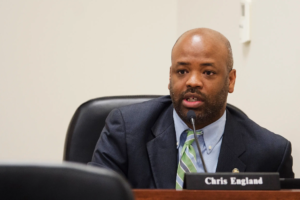
Rep. Chris England has consistently scrutinized ADOC contracts.
Appleseed isn’t sharing that data, as it involves a large-scale security measure, but the misstep is at least the second embarrassing instance involving Lunsford and his team’s work on Alabama prison litigation. A federal judge in July 2025 removed Lunsford and two other attorneys from a civil rights lawsuit when the attorney for the plaintiff notified the court that a filing by Lunsford’s team included incorrect information made up by artificial intelligence. State records show Lunsford’s team took in $172,396 in the case in which AI was used.
After Rep. England spent more than 20 minutes questioning ADOC’s representative about the requested additional millions to Lunsford during last week’s Joint Contract Review Committee meeting, state Sen. Dan Roberts, R-Mountain Brook, the committee chair, noted that the state was working toward construction of a new 4,000-bed prison and is “anticipating building another facility” but that construction is “a little behind schedule.” The enormous new prison, which has swallowed $1.3 billion in state funding, should insulate the state against future litigation costs, Roberts suggested, before adding: “It is a complicated, sticky wicket.”



Leave a Reply
Want to join the discussion?Feel free to contribute!