
Summary: Special Review of the Alabama Department of Corrections by the Alabama Department of Examiners of Public Accounts
This is the first report produced by the Department of Examiners of Public Accounts (ADEPA) as part of the State’s prison oversight pilot program, created and announced in March of 2026. The stated goal of the pilot was “to increase transparency, accountability, and independent oversight of conditions within Alabama’s prison system.” Nearly 400 pages, the audit contains a review of both the Alabama Department of Corrections (ADOC) central office and Kilby Correctional Facility. ADEPA covers a broad range of topics in both categories, highlighting issues and providing recommendations for improvement. The report also contains surveys completed by dozens of incarcerated people describing largely inadequate living conditions and limited services at Kilby.
Appleseed is providing this summary in order for lawmakers, impacted families, and other stakeholders to easily review these critical findings and recommendations.
EXECUTIVE SUMMARY
Pages 2-6
- Strengthen central office governance, accountability and independent oversight
ADOC often lacks an effective mechanism to coordinate responsibilities, verify performance, resolve deficiencies, and demonstrate accountability.
A stronger central office governance should include defined ownership of “policies, disciplinary actions, investigations, procurement and contract monitoring, ethics reporting, technology and physical security, constituent services, grievances, healthcare oversight, and corrective-action follow-up.”
- Create a unified policy, procedure, training, and communication system
ADOC should conduct a review of all Administrative Regulations, Procedures, contracts, forms, and manuals to eliminate conflicts and reflect current practices. This should be paired with additional training, particularly in areas involving discipline, grievances, constituent services, mental health, Prison Rate Elimination Act (PREA), responsibilities, incident reporting, security, healthcare, and reentry.
- Implement an integrated accountability, records, and performance management system
“At a minimum, the system should support complete, accurate, timely, and reconcilable records for employee discipline, use of force, inmate deaths, assaults, PREA matters, grievances, constituent inquiries, healthcare and mental-health services, training, contract performance, facility maintenance, security vulnerabilities, program participation, inmate identification, and reentry preparation”
- Stabilize the workforce and improve operational reliability, safety, and staff accountability
Auditors found that staffing shortages contributed to multiple weaknesses, not just gaps in post coverage. Weaknesses included surveillance activities, disciplinary processes, access to programming, delays in reentry preparation, and more. “Required duties relating to camera monitoring, PREA compliance, inmate grievances, reentry, medical and mental-health referrals, incident notification, and investigative review should be assigned to adequately trained personnel and independently monitored.”
- Prioritize a system-wide corrective-action plan for safe facilities, essential inmate services, and successful reentry
“The review identified deteriorating infrastructure, inconsistent access to basic services, limited programming opportunities, and ineffective communication mechanisms across facilities. These
conditions were associated with increased health and safety concerns, challenges in supervision and service delivery, and shortcomings in program participation and reentry preparation.”
Reviewers identified immediate priorities ranging from plumbing and pest control to medical-area safety and entrance security. They also recommended “minimum” service expectations for “nutrition, healthcare, mental-health and substance-use treatment, recreation, visitation, communication, grievances, and reentry.”
ALABAMA DEPARTMENT OF CORRECTIONS – CENTRAL OFFICE
Culture, Oversight and Governance
Pages 10-16
Issues
Reactive and Secretive Culture
- ADEPA highlights a culture at ADOC “that is often more reactive than proactive in addressing operational issues” and appears to have “an underlying sense of secrecy within the agency, whether perceived or actual.” ADEPA was required to route all inquiries and requests through ADOC’s legal division, and obtaining information was so difficult at times the department had to issue a subpoena to ADOC. ADEPA was not allowed direct access to ADOC employees without a representative from ADOC legal present.
- Access was so unusually restricted, especially for a department (ADEPA) tasked with oversight of state agencies, that ADEPA characterized it as a reflection of “significant disregard for the oversight functions that are essential to ensuring transparency, accountability and effective governance within ADOC and the prison system.”
Lack of Uniformity in Governance
- ADEPA reports ADOC’s management differs from facility to facility despite Administrative Rules and Regulations (ARs) that are supposed to be standard across facilities. There is “significant confusion” among ADOC personnel regarding ARs and SOPs (Standard Operating Procedures) and personnel often misstated ARs or misunderstood procedures actually taking place at the facility level.
- Some ARs are restricted, however ADOC could not articulate any real process for classifying ARs as restricted or identify the authority that permits the agency to designate certain regulations as classified.
Outside and Expensive Legal Services
- There are no attorneys housed at ADOC designated as Deputy Attorney Generals (DAGs). ADOC must rely on the Attorney General’s Office or outside counsel to represent the department in court leading to “inefficient use of agency resources” and contributing to “concerns regarding the consistency, quality, and reliability of legal guidance provided.”
- Contracts for outside legal counsel have, at times, reached the maximum spending authority and for others ADOC has amended contracts to “increase spending ceilings.”
Oversight Issues
- ADOC relies on many outside contracts, which “involve substantial financial commitments and complex service requirements,” but ADOC provides little oversight of these contracts.
- ADEPA found little monitoring of potential conflicts when it comes to contract vendors and provides an example: a current ADOC vendor contract was awarded to a company “where an ADOC employee is a close family member of an executive of the company.”
- ADOC failed to report any ethics violations from March 2025-September 2026, despite media releases of violations among employees.
- The Law Enforcement Services Division (LESD) conducts all investigations within the department and “employees may lack independence needed to conduct these investigations.”
Recommendations
- ADEPA recommends leadership at central office that will promote a culture change at ADOC, focused more on transparency and accountability.
- ARs and SOPs should be reviewed by legal, consistent across facilities, and housed in an accessible central repository.
- ADOC should have its own legal division, including DAG’s, to handle the department’s legal obligations.
- Contract monitoring should be thorough and managed by ADOC’s legal division.
- ADOC should ensure all ethics violations are documented and reported appropriately to the Ethics Commission.
- ADOC should consider asking lawmakers to explore removing LESD from the department and placing it with an independent entity like the Attorney General’s Office or the Alabama Law Enforcement Agency.
Personnel
Pages 16-19
Issues
- There has been a focus on recruiting/hiring COs using incentives like increased officer pay, but ADOC should also factor in the ways “workplace culture and safety conditions” contribute to officer retention.
- Disciplinary actions are not centralized. Some are handled only at the facility level and not documented thoroughly leading to a lack of consistency.
Recommendations
- “ADOC should prioritize improving the overall work environment to enhance staff retention within the prison system.”
- ADOC should have procedures in place for handling disciplinary actions to create more consistency and uniformity across the agency.
Inmate Quality of Life
Pages 19-22
Issues
- Feedback from inmates indicates many do not believe they are receiving adequate nutrition, especially on weekends and holidays. “Consistently, there is no reliable way to evaluate compliance or determine whether facilities are performing required procedures” as it relates to food services.
- Hours for visitation were cut during Covid from three to two hours and never readjusted after the pandemic. Start times are often delayed, cutting visitation time short for inmates and their loved ones, and vending machines in visitation areas are often understocked or broken.
- There is a shortage of available personal education devices (PEDs) which are used by inmates to communicate with family and friends and receive mail. Mail is deleted from the PEDs after six months. PEDs cost money, limiting who is able to use them.
- Inmate survey feedback revealed significant concerns about receiving legal mail.
Recommendations
- ADOC should explore ways to provide more food to inmates, especially on weekends and holidays.
- ADOC should ensure all policies regarding visitation are followed and in-person visitation begins on time.
- ADOC should make sure all inmates have access to a PED in order to access mail and communicate with loved ones. Policies around legal mail should be followed.
Constituent Services
Pages 22-26
Issues
- Outside of web-based submissions, pathways to submission of concerns to constituent services are not easily accessible to the public (i.e. submission via physical mail or email). The central physical address or email address is not included on the web-based submission form. Although there is a centralized email address for submissions, it is not readily available on ADOC’s website.
- ADOC has failed to implement a standardized process for constituent services leading to a lack in the necessary processes and procedures to ensure all submissions received are logged, documented, and tracked.
- Training for facility liaisons is largely informal and there seem to be no actual policies or procedures for liaisons to follow.
Recommendations
- ADOC should adopt and consistently follow all policies and procedures for constituent services. The department should “standardize how submissions and inquiries are received, recorded, categorized, assigned, investigated, escalated, resolved, and closed.”
- ADOC should implement quality-assurance practices beyond monthly JPOC reports. The department should use Constituent Services data to “identify recurring or systemic.”
Medical/Mental Health Services
Pages 22-31
Issues
Medical Services
- ADEPA found inconsistencies in individuals receiving medical care being searched upon entering and exiting the medical area, increasing “the risk of contraband movement” and compromising “the overall safety and security of the facility, medical staff, and inmates.” The process for filing medical and mental health grievances is unclear, as is the entity charged with investigating those grievances.
Mental Health Services
- Mental health vendors are required to establish and implement Mental Health Continuous Quality Improvement Programs (CQIP) as well as establishing performance monitoring standards. ADEPA struggled to obtain this information, and what they did obtain showed none of the facilities were achieving the mental health target thresholds.
- ADEPA struggled to obtain information regarding required mental health training. ADEPA learned there was no verification of whether all required staff had received training and no centralized process or standardized system to reschedule missed trainings.
Recommendations
- ADOC should implement consistent searches for individuals entering and exiting medical areas.
- The medical grievance process should be clearly defined and ADOC’s involvement in the review process should be clear so as to ensure the medical vendor is responding appropriately.
- All OHS policies and procedures should be centralized and available to ADOC personnel.
- All ARs related to CQIPs should be followed, and ADOC should appropriately monitor mental health vendors to ensure services are being adequately provided.
- ADOC should ensure mental health trainings are provided and develop a process to ensure all required staff receive them.
Programming/Reentry
Pages 31-34
Issues
- Both education and rehabilitative program availability varies and all programs are not available at each facility. This means a program that might benefit an inmate may not be available at the facility where they are housed, or an inmate may begin a program at one facility and later be transferred to a different facility where the program is not offered making it impossible for the inmate to complete the program.
- ADOC does not have trackable reentry plans.
- Given the voluntary nature of programs for many inmates who simply end their sentence, there is no incentive to participate, meaning some will leave custody without having benefitted “from the critical skills and rehabilitation these programs are designed to provide.”
- “Despite being a requirement since 2021,” many ADOC facilities have yet to begin providing non-driver identification cards.
- Limiting transportation to the county of conviction means a released individual “may be far from a destination that would better support their release and potentially without sufficient means to complete their journey.”
Recommendations
- Each inmate should have a trackable reentry plan that begins once they are incarcerated that includes educational and rehabilitative goals. These plans should affect facility placement unless there are specific security risks.
- ADOC should develop strategies that encourage and increase participation in voluntary programs, especially for those nearing the end of their sentence.
- ADOC should comply with state law by assisting all inmates in obtaining state-issued photo IDs prior to their release.
- ADOC should explore providing additional transportation assistance or flexible travel arrangements for individuals whose most supportive environment is not the county of their conviction.
KILBY CORRECTIONAL FACILITY – INSPECTION
Pages 35-51
Kilby is a maximum-security facility opened in 1969, originally designed for 440 people. Its current capacity is approximately 1,461. It serves as the intake and classification center for nearly all men entering Alabama’s prison system. At the time of inspection, 1,389 people were housed there. Examiners conducted an on-site inspection on August 18, 2026, examining nearly all major operational areas, including housing units, intake, visitation, medical areas, the kitchen, law library and recreational facilities. They interviewed staff and incarcerated people and reviewed facility records and policies.
Safety and Security Infrastructure of the Facility
Issues
- Front gate, back gate and visitation gate: Examiners found that they were not required to sign the visitor log. They also observed security personnel allowing an examiner selected for a randomized body scan to press the randomizer again, resulting in a manual search instead of the scan. Security procedures at the back gate were less stringent than those at the front gate. Examiners were told that incarcerated people, vendors and vehicles could enter the back-gate area before searches were conducted.
- The visitation entrance lacked some of the enhanced security measures used at the front entrance.
- Camera Surveillance: Although the facility’s camera system was reportedly operational, examiners found that prison leadership could not independently access it without assistance from other ADOC employees. They also visited ADOC’s Central Office camera-monitoring room and found it unattended, with no one monitoring cameras statewide. When inspectors attempted to locate the assigned monitoring officer: “They discovered the officer in another area of ADOC central office folding inmate uniforms.”
- Fire Safety: Fire extinguishers lacked evidence of required monthly inspections from January through July 2026. Examiners also questioned whether all housing units had adequate fire extinguishers, suppression systems and alarms. They could not determine whether existing fire suppression and alarm systems were operational.
Recommendations
- “ADOC should ensure the visitor log is consistently used for all individuals entering KCF and that all security procedures—particularly the randomized search selection process—are applied as intended.” “Searches should occur prior to vehicles and occupants entering the secured area to reduce opportunities for contraband introduction.” Improve camera system access, strengthen central office monitoring, formalize monitoring procedures and expectations, improve communication and response to camera outages and conduct periodic internal audits of cameras and monitoring practices.
Inmate Housing and Intake Units
Issues
- Heavy dust and cobwebs on ceilings, HVAC vents, fans and beneath beds. Dead roaches and other insects. Mold and mildew in shower areas. Dirty standing water and visibly unsanitary restroom facilities. Nonfunctioning showers, toilets, urinals and sinks. Showers that ran continuously and could not be shut off. Standing water caused by inadequate drainage and rusted pipes and broken shower tiles.
- Dorms H and J had no HVAC systems and relied on fans. Several other dorms were noticeably hot despite having HVAC systems. Dust accumulation was widespread in ventilation systems. Restricted housing Dorm F’s shower room was closed because its floor structure was shifting and caving in. Broken and chipped shower floors appeared in multiple dorms. Exposed electrical wiring was observed in Dorm N. Broken lighting was reported in multiple housing units.
- The geriatric/infirmary dorm (P) had numerous sanitation and plumbing deficiencies despite housing people who were older, ill or infirm. The mental health dorm (O) had damaged cell-door glass, unsanitary showers and inadequate lighting.
- Incarcerated people reported receiving insufficient time to eat. Staff gave inconsistent answers about meal periods, ranging from seven to 15 minutes. The dining area appeared too small to accommodate incarcerated people efficiently. Examiners also found excessive heat, malfunctioning food-warming equipment, broken lighting, leaking pipes, rust and damaged kitchen equipment. The visitation building was noticeably warm and all vending machines were empty, leaving incarcerated people and visitors without access to snacks or drinks.
- In nearly every housing unit inspected, incarcerated people reported inadequate access to cleaning supplies. Leadership said requests to purchase additional cleaning supplies using the facility’s institutional account had sometimes been denied by ADOC Central Office.
- Examiners tested inmate telephones and found that several did not have dial tones. The report notes that these phones are important for accessing the PREA hotline to report sexual abuse, harassment or threats.
Recommendations
- Issues identified during the inspection should be addressed in a timely and consistent manner, staff should monitor the cleaning of the facility by inmates, “especially in the infirmary/geriatric unit where inmates cannot do so themselves.” Incarcerated men should be provided adequate time to eat, and the physical condition of the kitchen and dining hall should be addressed.
KILBY CORRECTIONAL FACILITY
Pages 52-76
Personnel
Page 53
Issues
- Employee Disciplinary Actions: ADOC reported 300 disciplinary actions involving prison employees between October 2023 and September 2025. Examiners found that 26% of disciplinary actions documented in sampled personnel files were missing from ADOC’s electronic disciplinary system.
- One particularly significant example involved a correctional officer with multiple excessive-force incidents. A previous three-day suspension was missing from the electronic system. A subsequent excessive-force incident resulted in a recommended 10-day suspension that was reduced to one day.
- Because the earlier incident was missing, the employee’s disciplinary history was not properly considered. According to the report, the second incident should have resulted in a recommendation for termination, and yet “the individual remains employed as a CO and now has 3 excessive use of force incidents over the course of their career.” Examiners also found that disciplinary actions were missing from some employee performance appraisals, resulting in employees receiving pay raises they were not entitled to receive.
Recommendation
- ADOC should develop a review process to ensure all disciplinary action is accurately captured and filed in the correct section of the employee’s personnel file, and the prompt disciplinary action by supervisors and entry into the system within the 10-day timeframe as required by ADOC policy.
Inmate Quality of Life
Pages 54-58
Issues
- Canteen Fund: Prison staff reported that requests to purchase basic inmate necessities, including uniforms and cleaning supplies, had sometimes been denied by Central Office.
- Recreation: Incarcerated people have access to outdoor activities, including basketball, volleyball, gardening and weightlifting. However, examiners observed only two areas with weightlifting equipment, which they considered insufficient for the population. Some incarcerated people also lack access to electronic devices used for entertainment.
Recommendations
- ADOC should evaluate whether inmates are given an adequate amount of time to eat and make adjustments if needed, ensure vending machines are stocked prior to visitation and any denial of an expense should be clearly documented and explained to the facility’s staff.
Grievance Process
Pages 59-62
Issues
- Grievance forms and policies were not available electronically through devices, and ADOC was not accepting electronic grievance submissions. The coordinator did not conduct facility visits and did not regularly review individual grievance files.
- Grievance forms were not consistently available, and incarcerated people had to request forms from correctional officers, potentially including officers against whom they intended to file complaints. The same employee handled multiple grievance-processing responsibilities without independent review. One grievance involved a man whose dentures were reportedly lost during a hospital visit. The man could not obtain replacement dentures through the dental provider because its policy generally limited replacement to once every five years. Even if the inmate successfully pursued compensation through the Board of Adjustment, he could not use his own funds to purchase replacement dentures while incarcerated.
- Examiners also identified delayed responses to grievance appeals and inadequate documentation to establish whether responses were delivered within required deadlines.
Recommendations
- ADOC should ensure its policies related to the grievance process establish consistent procedures regarding the maintenance of inmate grievance files across all facilities, reviews how each facility administers the process and implements ongoing monitoring.
Medical/Mental Health Services
Pages 67-73
Issues
- Inmate Medical Privacy: Examiners observed incarcerated people sitting, standing and walking outside an open medical examination room while another inmate was receiving medical treatment. One inmate was on an examination table with the door open and without a closed privacy curtain.
- Infirmary Condition: Examiners found significant cleanliness and safety problems in the infirmary, including excessive heat, bugs around the microwave, dirty laundry on the floor, broken showers, malfunctioning shower heads, dirty floors and a visibly dirty tub, all of which posed heightened risks for incarcerated people recovering from illnesses.
- Management of Medical Service Tools: Examiners found multiple unsecured needles and syringes in a medical laboratory. The room’s door was open to a hallway where incarcerated people were waiting for medical intake. The medical instruments were stored outside a locked cabinet, contrary to ADOC’s restricted policy.
- Mental Health Referrals: ADOC provided inconsistent data on the number of mental health referrals at the prison. Examiners could not reconcile the figures in two separate reports.
- Outpatient Mental Health Services: The prison provides individual and group counseling, including anger and stress management programs, but ADOC’s reports contained significant inconsistencies in the number of incarcerated people attending group counseling. Some figures appeared to represent the number of sessions rather than the number of participants, making it impossible to determine actual participation.
- Substance Abuse Programs: The prison does not currently offer substance abuse treatment programs. The facility’s Mental Health Director identified substance abuse treatment as the greatest area of need within the facility’s mental health program.
Recommendations
- ADOC should strengthen medical and mental health services by protecting patient confidentiality, securely storing medical supplies, and ensuring inmates receive timely appointment notifications. It should improve access to and tracking of mental health referrals and counseling, expand substance-use treatment availability and monitor program participation, completions and waitlists..
Programming/Reentry
Pages 74-76
Issues
- Educational Programming: The prison offers adult basic education but does not offer career technical education programs through J.F. Ingram State Technical College. Consequently, incarcerated people do not have access to vocational training that could provide marketable employment skills before release.
- Rehabilitative Programming: The prison does not have a dedicated reentry employee. One employee is responsible for intake assessments, identifying appropriate programs, conducting rehabilitative workshops, administering tests and obtaining identification documents for incarcerated people approaching release. Approximately 120 incarcerated people signed up for the employee’s last workshop, but she could accommodate only 20 at a time. Examiners could not determine how many rehabilitative programs were actually conducted because ADOC did not provide complete attendance records.
Other Reentry Services
Page 76
Issues
- Reentry Program: ADOC’s six-module prerelease life-enrichment program, designed for incarcerated people within 30–90 days of release, was not available at the prison.
- Identification: Although state law requires assistance obtaining identification documents, the prison did not consistently obtain birth certificates and Social Security cards for incarcerated people approaching release. Records showed that these documents were not ordered for incarcerated people reaching the end of their sentences between April and August 2026. The employee responsible for ordering them said she could not perform the task during that period because of other responsibilities. Audits of Identification Ordered: Required quarterly audits of identification-document orders were not being performed consistently. Examiners found that the audits were conducted by the same employee responsible for ordering the documents, were not dated and did not appear to have been completed quarterly.
Recommendations
- ADOC should expand the prison’s educational and vocational training, strengthen reentry services, establish consistent standards for tracking program participation and effectiveness, and implement prerelease programming. It should also ensure they receive needed identification documents and conduct independent quarterly audits to verify compliance.
Facility Incident Reporting
Use of force
Pages 79-83
Issues
- The prison reported 302 use-of-force incidents between October 1, 2023, and September 30, 2025. Of those, 262 were classified as justified, 13 unjustified, 18 unfounded and seven inconclusive. One had no final determination and one had no documentation. ADOC’s Law Enforcement Services Division did not identify any use of force incidents that were referred to them by the prison for further investigation during the review period.
- ADEPA found significant gaps in documenting notifications and supervisory reviews:
- 57% of sampled files lacked documentation that required ADOC personnel had been notified.
- 80% lacked documentation that preliminary reviews were forwarded to appropriate ADOC officials.
- None documented the required 48-hour facility review or completion and uploading of the investigation within 10 days.
- None documented Regional Directors’ monitoring of review timeliness.
Recommendations
Document required notifications and ensure reports are forwarded to appropriate ADOC officials. Complete supervisory reviews within required time frames and upload investigations promptly. Document Regional Directors’ monitoring activities.
Physical assaults
Pages 84-86
Issues
Examiners found that the prison generally documented its own assault investigations, but important gaps remained in investigative findings, referrals and timelines:
- The prison reported 151 physical assaults, including 10 considered serious enough to be referred to LESD. Incident reports did not document the final investigative findings or disciplinary outcomes.
- ADOC could not confirm whether a serious assault the prison said it referred to LESD was actually investigated.
- 60% of sampled LESD cases lacked documentation of required notifications.
- 60% lacked an incident report documenting the circumstances.
- In 50%, there was no documentation showing an investigator had been assigned and begun work.
- Some investigations exceeded required time frames or lacked final reports.
Recommendations
Include investigative findings and disciplinary outcomes in incident reports. Ensure serious or life-threatening assaults are investigated by LESD, or document why an investigation is not warranted. Document required notifications and incident reports. Establish standard investigative time frames and require explanations for delays.
Inmate deaths
Pages 87-92
Issues
- ADOC publicly reported 68 deaths at Kilby during the review period. ADEPA found inconsistencies among ADOC’s death lists: LESD initially listed 66, Kilby listed 72, and quarterly reports listed 68. The differences were eventually reconciled, partly because deaths following transfers to outside hospitals were attributed differently.
- During interviews with ADOC’s LESD staff, they stated that when investigating a death they would like to have an autopsy performed on each inmate that perished in the custody of ADOC. “However, ADOC’s LESD staff stated ADOC is not able to obtain autopsies from ADFS without the respective coroner or district attorney signing off on the request.”
- “The data tracking for inmate deaths is inconsistent across ADOC. Inconsistencies in data reporting can lead to inaccurate reporting by ADOC creating an environment of ambiguity where transparency is critical.”
- There were no copies of death certificates in the prison’s files. Because ADOC does not obtain copies of the death certificates “there is a possibility the cause of death noted in ADOC’s investigation file could conflict with the official cause of death noted on the death certificate.”
- Other findings included:
- ADOC had no policy defining how deaths should be classified as homicide, natural, overdose or undetermined.
- Autopsies were documented in only 48% of sampled cases.
- 28% lacked documentation of required internal notifications.
- 10% lacked documentation that the coroner, ADFS or another outside entity was notified.
- 16% lacked an initial investigative report completed within 24 hours.
- Some files lacked toxicology reports or documentation of next-of-kin notification.
Recommendations
- Establish consistent definitions for classifying deaths.
- Evaluate contracting with an authorized entity to perform autopsies on all who die in ADOC custody.
- Standardize how deaths are attributed to facilities and how death data are compiled.
- Document required notifications, toxicology results and next-of-kin contacts.
- Ensure initial death reports are completed within 24 hours.
- Consider obtaining official death certificates for investigative files. “Developing policies and standard operating procedures for how a death is connected to a facility will allow ADOC to be more transparent in their reporting of data and would also allow ADOC to produce more accurate, reliable, and understandable data in their public facing reports.”
Sexual harassment and sexual assault
Pages 93-105
Issues
- Kilby reported 16 sexual harassment allegations and 100 sexual assaults during the review period. LESD separately reported investigating 96 sexual assault cases.
- Examiners identified discrepancies between the lists and significant evidence-retention and documentation problems:
- Four cases on LESD’s list were missing from the prison’s list; seven reported assaults had no corresponding LESD investigation files, including one staff-on-inmate allegation.
- 64% of sampled sexual assault cases had no retained video evidence. “81% of the cases without video footage simply stated the footage was not available but did not elaborate as to why the footage was not available.”
- A significant percentage of cases lacked important evidence, documentation, mental health care for the victim or retaliation monitoring.
- The federal Prison Rape Elimination Act (PREA) requires ADOC to confirm the telephone system is checked daily to confirm PREA hotlines are operational. Examiners inspected 31 days of the hotline check log and the phones were listed as inoperable for 21 of those days, but the numbers were widely varying between shifts.
- ADOC policy states LESD shall refer all criminal cases to the local District Attorney’s office, but a review of all 96 sexual assault investigation reports note only 3 of the cases were referred to the local District Attorney or appropriate prosecutorial authority for review. “Additionally, 1 investigation case file contained no documentation as to whether the incident was referred to the local District Attorney’s office or appropriate prosecutorial authority for review. All cases were noted as being considered criminal.”
Recommendations
- Ensure all sexual assault and harassment allegations receive the required investigation and maintain consistent incident records.
- Preserve video evidence for at least one year and establish procedures to retain footage even when investigations are delayed.
- Include medical body charts and forensic examination results in case files.
- Document separation of victims and suspects.
- Train staff on required mental-health referrals and retain referral documentation.
- Document investigation findings, notifications and required retaliation monitoring and refer sexual assault cases to the local District Attorney’s office for review of potential charges being brought forward. “The decision of whether to prosecute should not be made by ADOC’s investigative agents but left to the discretion of prosecutorial agencies.”
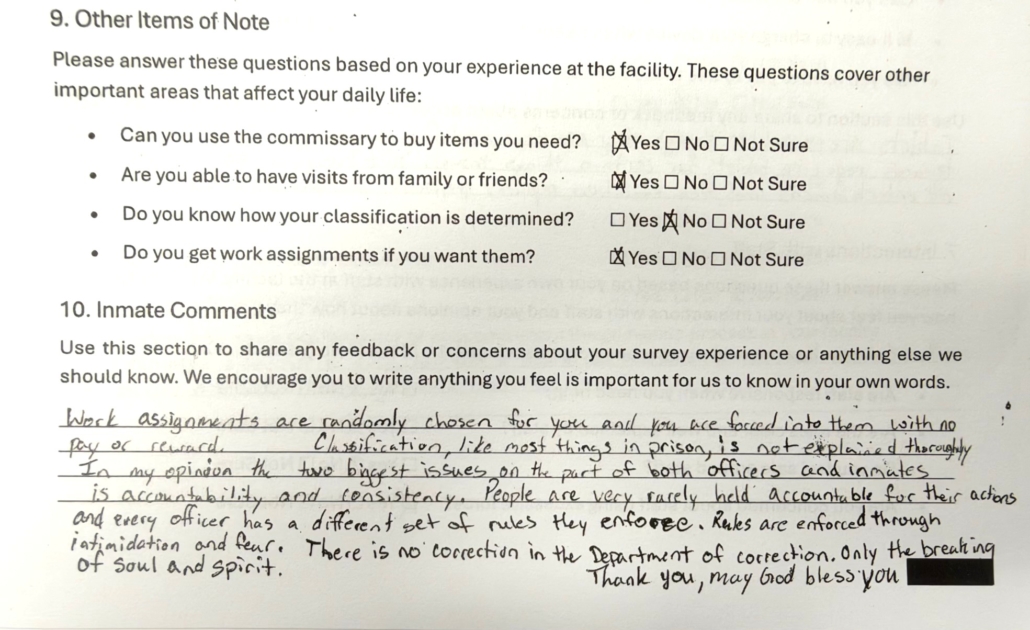
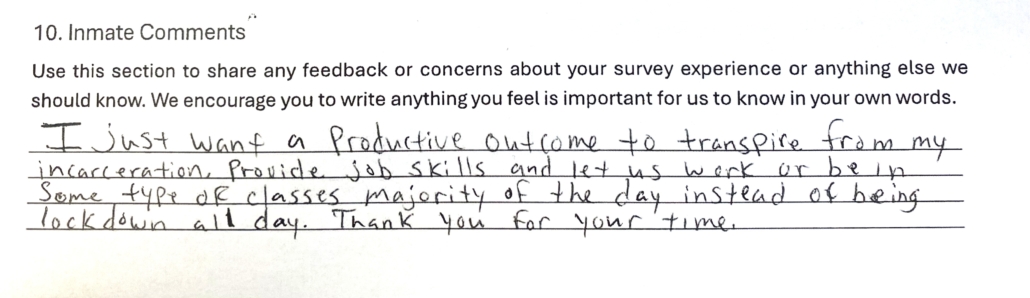
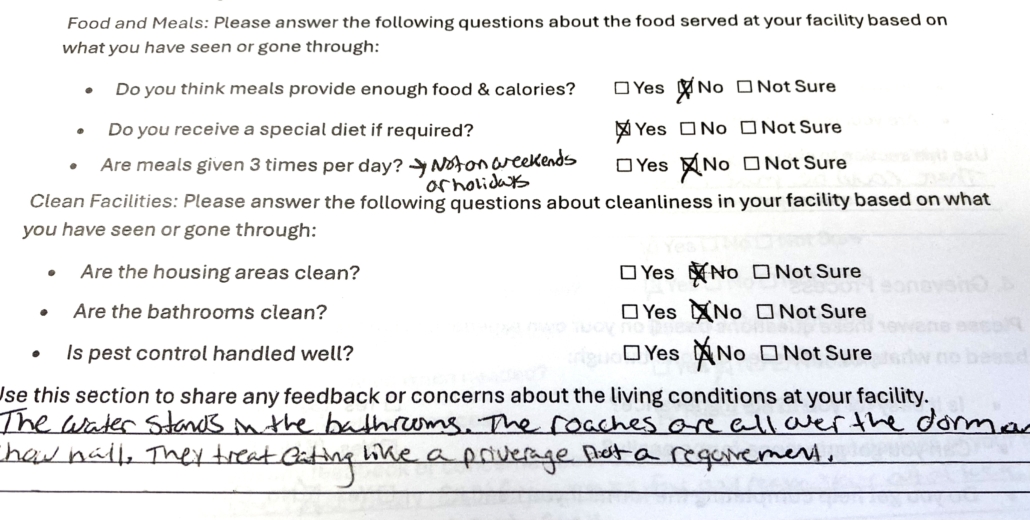
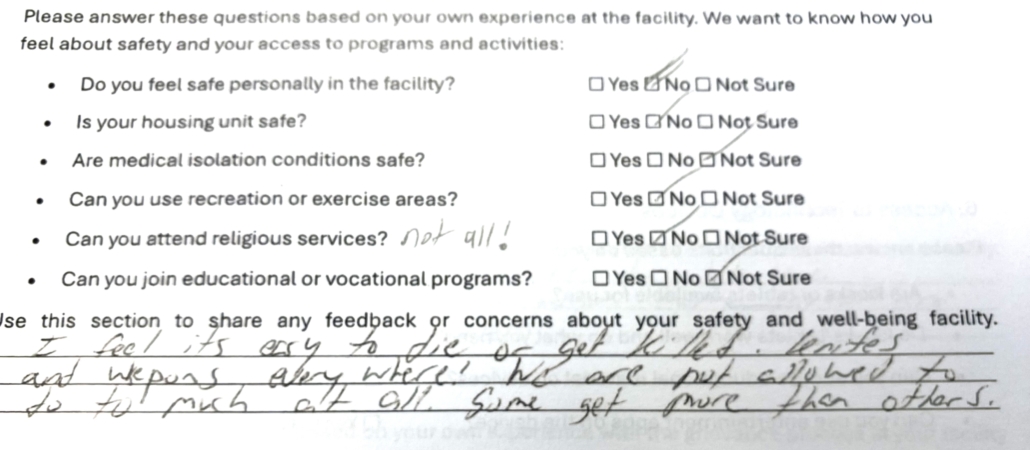
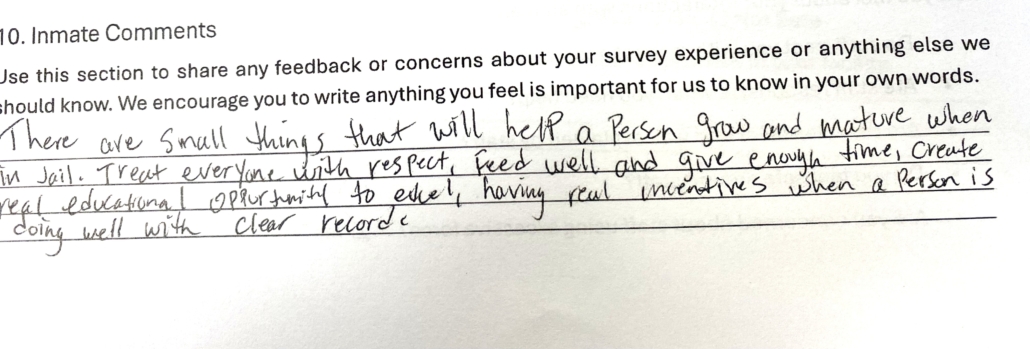
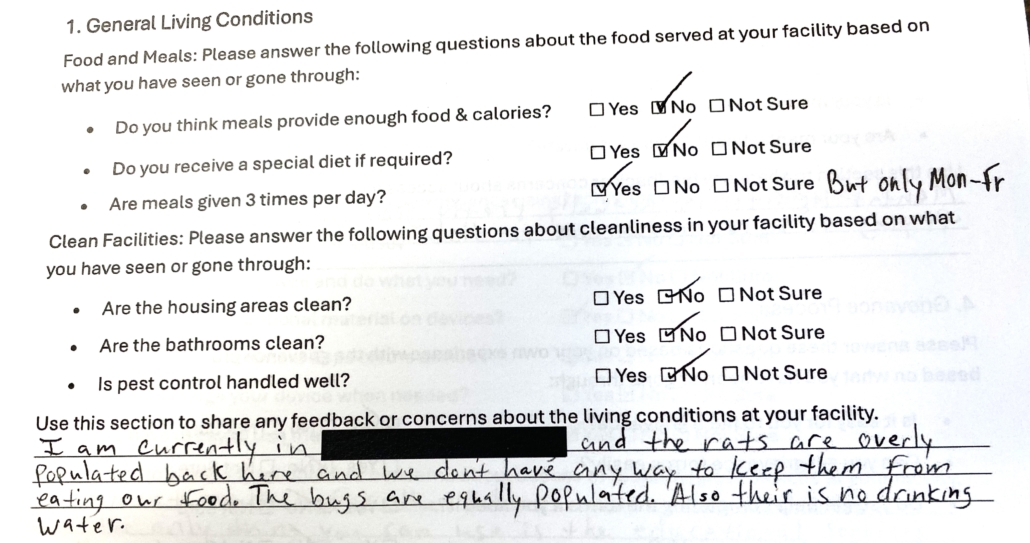
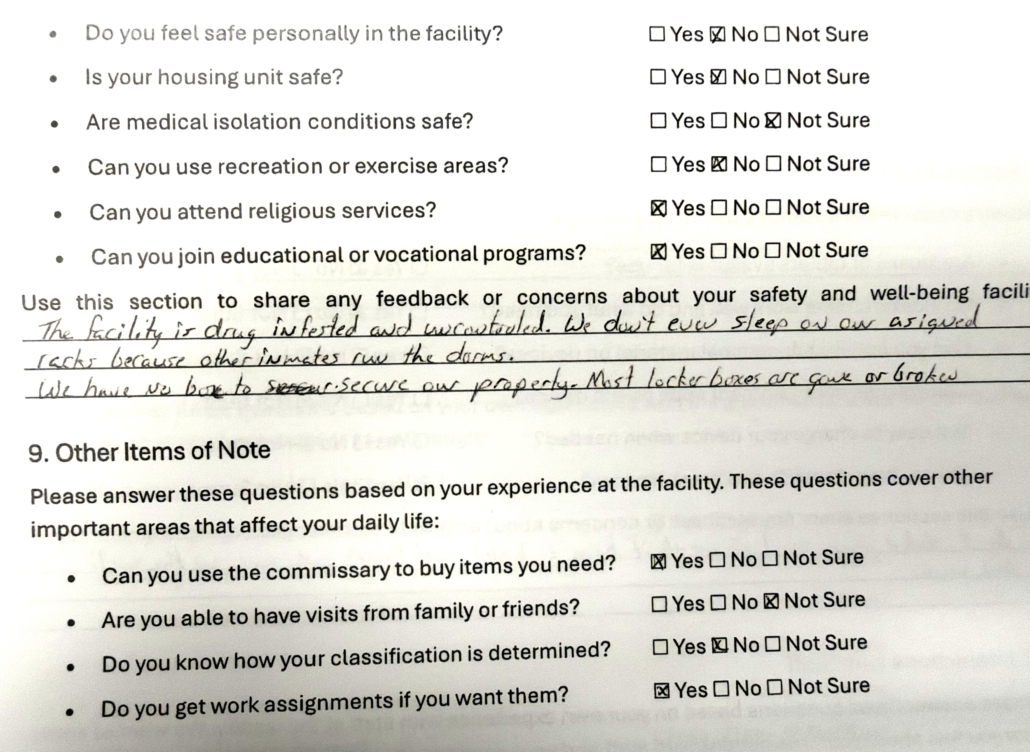
KCF INMATE SURVEYS
The audit includes 58 inmate surveys conducted between July 7th through July 31st. The surveys and responses can be found beginning on page 119. A sampling:
APPENDIX
The appendix includes acronyms used throughout the report, an inmate population count, and a canteen price list for KCF. The appendix can be found beginning on page 111.
ADOC RESPONSE
ADOC provided a response to ADEPA’s report. The response can be found beginning on page 351.
A complete copy of the report can be found here.


Leave a Reply
Want to join the discussion?Feel free to contribute!