

Seven years and 1,700 deaths after shocking DOJ report, federal prison conditions lawsuit set for trial Nov. 30
By Eddie Burkhalter, Appleseed Researcher
Attorneys for the U.S. Department of Justice (DOJ) and those representing the State of Alabama and the Alabama Department of Corrections (ADOC) met in a hearing at the federal courthouse in Huntsville on Friday to hash out details before the federal government’s trial over the state’s embattled prisons for men starts on Nov. 30th.
U.S. District Judge Harold Mooty III said he believes the trial could last six weeks. He has set aside eight weeks in his court’s schedule for the trial. If the trial takes longer, “we’re going to do what has to be done.”
The private Alabama attorney William “Bill” Lunsford, who was an appointed state Deputy Attorney General and who is trying the case for ADOC and the state, came into the courtroom with 10 colleagues from his law firm, Butler Snow. The DOJ was represented Friday by lead counsel Carla Ward and four additional DOJ attorneys.
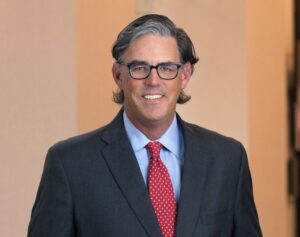
Attorney Bill Lunsford of Butler Snow
There will be no open or closing arguments presented at trial, Judge Mooty said, which is to be a bench trial decided by Mooty himself and without a jury. The courtroom will be open to the public and the press, but seating is limited to approximately 65 people in the courtroom and another 75 in an overflow room inside the courthouse that will include a live video and audio feed of the proceedings. Once the courtroom and overflow room are at capacity all others will be turned away at the courthouse door.
Judge Mooty sternly cautioned both sides that he wanted no unnecessary delays during the trial, and warned that any witness intimidation would be dealt with according to the federal laws protecting witnesses, telling the assembled attorneys that witnesses, including incarcerated people, “must be allowed to testify freely” and that intimidation also includes any such actions taken by other incarcerated people or Alabama Department of Corrections (ADOC) staff.
Large sections in the witness lists and exhibits filed in the case were filed under seal, meant to protect the witnesses and people connected to those exhibits, but the judge explained that such parts of those protections would be revisited once the trial begins.
Carla Ward, lead counsel for the U.S. Department of Justice, expressed concern to the judge that the federal government hasn’t been allowed by ADOC to talk with expected incarcerated witnesses on phone lines that aren’t monitored by ADOC, and the government needs to ensure those witnesses are prepared to testify.
Lunsford said because the DOJ isn’t arguing that those conversations are privileged (meaning the witnesses aren’t clients of the federal government and communications between them protected by law, but are instead witnesses in this case, the law doesn’t require unmonitored phone lines in these instances. Both sides were already in talks on this matter, attorneys for both sides said, and Judge Mooty asked them to continue those talks. If the dispute isn’t settled he’ll hold a telephone conference with both parties.
The DOJ published its initial report in 2019 detailing the widespread, horrifying abuses, unconstitutional levels of violence, sexual assault, and excessive force by guards fueled by extreme mismanagement, dysfunction and corruption across Alabama’s prison system for men. 
More than seven years ago, the DOJ first told Gov. Kay Ivey and state leadership:
“There is reasonable cause to believe that the Alabama Department of Corrections (“ADOC”) has violated and is continuing to violate the Eighth Amendment rights of prisoners housed in men’s prisons by failing to protect them from prisoner-on-prisoner violence, prisoner on-prisoner sexual abuse, and by failing to provide safe conditions, and that such violations are pursuant to a pattern or practice of resistance to the full enjoyment of rights secured by the Eighth Amendment. The violations are severe, systemic, and exacerbated by serious deficiencies in staffing and supervision; overcrowding; ineffective housing and classification protocols; inadequate incident reporting; inability to control the flow of contraband into and within the prisons, including illegal drugs and weapons; ineffective prison management and training; insufficient maintenance and cleaning of facilities; the use of segregation and solitary confinement to both punish and protect victims of violence and/or sexual abuse; and a high level of violence that is too common, cruel, of an unusual nature, and pervasive.”
The DOJ filed suit in December 2020.
Since the DOJ’s 2019 report was published, there have been more than 1,700 deaths inside Alabama’s prisons. At least 202 people died inside Alabama prisons in 2025, Alabama Appleseed discovered through a records request to the Alabama Department of Corrections (ADOC). Alabama’s prisoner mortality rate in 2025 was 957 deaths per 100,000 people, compared with a national average across state prisons of 330 deaths per 100,000, according to the U.S. Department of Justice Bureau of Justice Statistics.
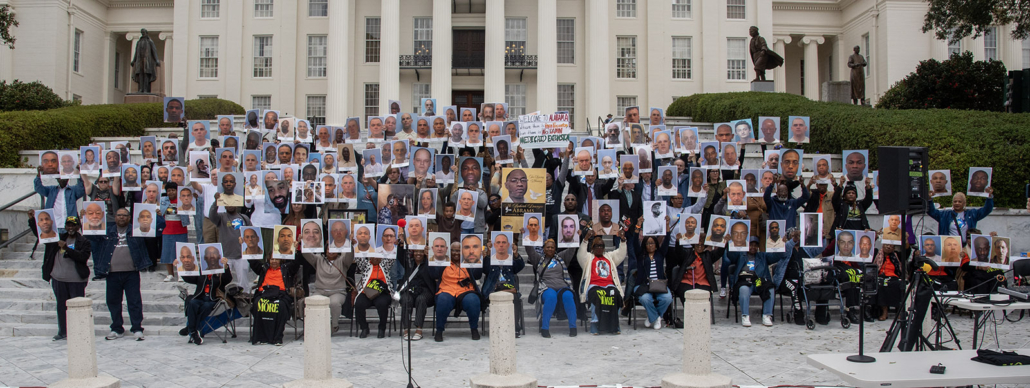
On Ash Wednesday, Alabamians gathered on the Capitol Steps to remember those who died in state prison custody. Photo by Bernard Troncale
The Civil Rights of Institutionalized Persons Act (CRIPA) of 1980 is a federal law meant to protect people incarcerated in state and local prisons and jails and other group settings. The DOJ’s 2020 CRIPA lawsuit against Alabama is one of many the federal government has filed since the law’s inception, but one of very few that is headed to trial. At issue is whether the conditions outlined in the complaint are part of a pattern or practice of denying constitutional rights to prisoners, and whether state officials have been deliberately indifferent to a known risk of such conditions.
In most of those other states where a lawsuit is filed, the cases are adjudicated through settlement agreements or consent decrees prior to going to trial, where the outcomes are uncertain, the costs to states in legal fees can be exorbitant, and the abuses persist as the cases drag out.
This is the first CRIPA case for Judge Mooty, who was nominated to the bench by President Donald Trump in August 2025 and confirmed by the U.S. Senate in October that year.
The DOJ has a list of 169 witnesses the deferral government plans to call, and hundreds more who could be called to testify, court records show. The state’s witness list includes the names of 127 witnesses, some of whom are also incarcerated people, Lunsford said Friday.
The state’s primary response to the lawsuit has been to spend $1.3 million on construction of a 4,000-bed mega-prison. This week, Alabama House Speaker Nathaniel Ledbetter, who has been monitoring the construction process, published a letter to Gov. Ivey in which he called for investigation of that project and described it as “complete and total chaotic mess.” The prison’s expected opening date is at least a year later than promised.


Leave a Reply
Want to join the discussion?Feel free to contribute!