Alabama Appleseed seeks an Executive Assistant to manage a wide range of administrative duties and provide development support. The Executive Assistant works closely with the Executive Director and reports directly to the Executive Director. This position requires excellent organizational skills, communications skills, and the ability to work independently in a fast-paced, nonprofit environment. An ideal candidate can manage spreadsheets, update a donor database, keep the office stocked with supplies, and troubleshoot with Spectrum when the internet is down. Mail merge, Mail Chimp, and basic graphic design skills are a plus, but not required.

Previous administrative, paralegal and/or office management experience is preferred. This is a full-time position based in Appleseed’s Birmingham office, although a 30 to 32-hour week role would be considered if the candidate possesses proven experience in a similar setting.

Our office can be calm one day, energetic the next. Comfort with the unexpected and an ability to adjust to new experiences are musts.  

 Responsibilities:

  • Assist leadership in responding to letters, emails, and requests from a wide range of stakeholders;
  • Provide support in coordinating meetings and public events;
  • Assist in managing Appleseed’s offices through maintaining office equipment, ordering supplies, communicating with vendors, and troubleshooting when related issues arise;
  • Organize and utilize excel development spreadsheets and Little Green Light donor database;
  • Manage mass mailings;  
  • Contribute to other organizational needs as might arise in a small nonprofit, particularly related to organization-wide projects such as the Celebrate Justice annual event, report distributions, and board meetings;
  • Assist in managing Executive Director’s schedule (occasionally);
  • Arrange some travel;
  • Assist with expense reports and filing of various documents;
  • Manage on-boarding of new employees.

Qualifications:

  • Demonstrated commitment to Alabama Appleseed’s mission, vision, and approach to advocacy;
  • Two or more years of experience as an administrative assistant or office manager preferred;
  • Highly proficient in Excel, Microsoft, Powerpoint, adobe and Google docs;
  • Excellent written communication skills;
  • Strong initiative and ability to manage and complete tasks with minimal supervision;
  • Commitment to working in an office setting full time;
  • Ability to get along and work collaboratively with diverse personalities;
  • Valid Alabama drivers license.

​Salary and Benefits: This position offers a competitive nonprofit salary range of $45,000 to $55,000, depending on experience, along with a benefits package including health insurance, generous paid leave, and 401(k) after one year; reimbursement of travel-related expenses.

To Apply: Send a cover letter, resume, and three references to Appleseed’s Executive Director, Carla Crowder, at carla.crowder@alabamaappleseed.org. Applications will be reviewed on a rolling basis and accepted until the position is filled. Please write “Executive Assistant” in the subject line. 

The injustices that we are fighting in Alabama today are directly connected to long histories of inequality and oppression in this state. As we build our team to fight for a better Alabama, we know that people who have historically been overlooked need to lead. For this reason, we welcome and strongly encourage applications from people of color, women, people with criminal histories, people from working class backgrounds, and LGBTQ people.

Alabama Appleseed values an inclusive culture and diverse workforce. Alabama Appleseed encourages applications from all qualified individuals without regard to race, color, religion, gender, sexual orientation, gender identity or expression, age, national origin, marital status, citizenship, disability, veteran status, and record of arrest or conviction. 

About Alabama Appleseed: ​Alabama Appleseed is a nonprofit, nonpartisan 501(c)(3) organization founded in 1999 whose mission is to achieve justice and equity for all Alabamians. Alabama Appleseed conducts integrated culture and policy change campaigns to confront laws and policies that harm the poor and to remedy the root causes of poverty and injustice. Its campaigns use policy analysis, research and documentation, legislative action, public education, community organizing, coalition building, direct legal representation and reentry services. Alabama Appleseed is a vibrant, growing organization that prides itself on creating strategic, evidence-based solutions to some of the most pressing problems in Alabama, and allowing the ingenuity of our staff to lead the way. We achieve our mission through a unique hybrid model: providing legal representation and reentry services to wrongly sentenced Alabaimans and conducting research and policy advocacy to reform the systems that created Alabama’s criminal justice crisis.

Alabama Appleseed is a member of the national Appleseed Network, which includes 18 Appleseed centers across the U.S. and in Mexico City.

Ronnie Peoples on his release day from St. Clair Correctional Facility. Joining him are Researcher Eddie Burkhalter, Executive Director Carla Crowder, St. Clair trade school instructor Bradley Black, Mr. Peoples, Staff Attorney Scott Fuqua and trade school instructor Chad Spurlin.

By Eddie Burkhalter, Appleseed Research


Ronnie Peoples stood alongside Bradley Black in St. Clair Correctional Facility and the two men hugged before Mr. Peoples walked outside as a free man for the first time in 33 years. 

Mr. Black, a welding instructor at the prison’s trade school, worked for decades alongside Mr. Peoples, who kept track of the tools for the instructor, a critical job in a prison. “When you get outside, smell the air,” Mr. Black told Mr. Peoples. “It smells different.” 

Mr. Peoples with his attorney Scott Fuqua.

Mr. Peoples, 69, took a couple steps outside the prison’s door and standing in the misty December morning, took a deep breath. “I smell it. Smells different,” he said as Appleseed staff walked him outside to start his life anew. 

Mr. Peoples has served more than three decades of a life without the possibility of parole sentence under the state’s Habitual Felony Offender Act (HFOA). He is among the growing number of very sick and older incarcerated people in Alabama. He was diagnosed with stage four prostate cancer in April 2023. The disease has spread to a lung and to a rib, and with Appleseed attorney Scott Fuqua’s help, Mr. Peoples applied for and was granted a medical furlough. 

“Last night was probably the longest night of my whole life,” Mr. Peoples told Appleseed’s Executive Director, Carla Crowder, just outside the prison. He didn’t sleep much, and instead thought about those who were coming to get him the next morning, about seeing family for Christmas whom he hasn’t seen in decades, including a 10-year-old grandson he’s never met. He thought about family most of all. 

Mr. Peoples received his life without the possibility of parole sentence after a 1991 robbery of a beverage company conviction in Tuscaloosa County. No one was injured. His sentence was enhanced under the HFOA because of prior robbery convictions more than four decades ago in the 1970s, including in Ohio. Life without parole was the only available sentence at the time, but because of changes to Alabama sentencing laws, Mr. Peoples would have been eligible for a much shorter sentence if current laws applied to his case. Last year, Appleseed profiled his situation in a series of reports about the Cruel and Unusual conditions in Alabama’s prisons.

Mr. Peoples with his trade instructors Bradley Black and Chad Spurlin.

“The whole block started clapping,” Mr. Peoples said of walking through the prison before his release. 

His road to freedom was long. 

In 2005, Mr . Peoples asked the court to reconsider his sentence, and Mr. Black, in a letter to the judge 18 years ago wrote: “He is an excellent worker and a person whom I can count on and trust. .. I normally do not write letters for the inmates. When Ronnie asked me to write this letter for him, I felt it was the least I could do for someone who has helped me so much and has never asked for anything in return.”

While Mr. Peoples application was approved by ADOC Commissioner John Hamm, medical furloughs aren’t easy to get in Alabama. Of the 30 medical furlough applications received in 2023, ADOC approved 10, according to the department’s report. However, three applicants died during the review process. Approvals were similar in other recent years: 10 for medical furlough in 2021 and nine in 2022. 

Mr. Peoples poses for pics with Bradley Black.

Treatment for his cancer while incarcerated was lacking, Mr Peoples explained, and getting timely medical information on his condition was difficult. He’d often go many weeks without a checkup, and planned lab work would be missed. He had his last lab work done about a week before release, and said he’s hopeful he’ll receive better treatment in the free world. 

Appleseed’s reentry team is assisting with all of the wraparound services he will need, including assisting with access to Social Security and Medicare.

“There’s going to be a whole lot of tears shed,” Mr. Peoples said of when he’d see his sister and other family members later that day. “My sister. She can’t stop crying, every time I call her…I just want to enjoy the Christmas spirit with my family.” 

“Alabama Appleseed is a natural bridge between the diversity, equity, and inclusion work that I have done in high school and what I plan to do in college. I am so grateful to Appleseed for the opportunity to learn about the problems that impact justice-involved people in Alabama and see what it means to be an advocate!”

Katia Apedoh just graduated from Hoover High School, where she served as leadership for Student Diversity Council, captained Ethics Bowl, and received her International Baccalaureate (IB) Diploma. Katia was very active with diversity work within the Hoover City Schools District, even developing a diversity initiative for teachers for which she received the 2024 Alabama Princeton Prize in Race Relations. In the fall, Katia will attend Washington and Lee University where she plans to double major in English and Politics with a minor in Law, Justice, and Society. Katia hopes to attend law school.

The Birmingham Re-entry Alliance is an innovative, collaborative reentry support and case management system for individuals returning to Birmingham following incarceration in state prison. Our network will combine the necessary services for some of Alabama’s most marginalized people – indigent, formerly incarcerated people with felony records – to thrive following incarceration. The organizations involved have proven records of providing the necessary services, yet no organization currently does all that is needed for people returning from prison to escape poverty and homelessness, and avoid returning to prison. By combining strengths of existing social service agencies and adding case management, this project builds a scalable system of support and care to help fill a desperate need.

Overview
The case manager serves as a lighthouse to assess clients for the program and guide them to coordinating service providers in the Birmingham Re-entry Alliance. In this role, the case manager will support individuals who are transitioning from incarceration back into the Birmingham area. The case manager is responsible for client assessment, referral to appropriate service providers, career planning, and goal setting. The case manager is to expect to work with a group of approximately 5 to 15 clients at any given time. Importantly, the case manager will have access to a supportive alliance of nine direct service providers (community partners) who have joined together to provide various services to formerly incarcerated clients. 

Primary responsibilities

  • Work closely with community partners to provide a seamless network of support services to clients newly released from state prisons into Birmingham;
  • Collaborate with other team members to address the immediate needs of clients, specifically, acquisition of government identification and benefits, medical care, transportation, education/job-training, employment, peer support, and housing;
  • Respond to urgent client needs and questions by providing leadership, direct services, and coordination with needed community services;
  • Create client files including medical history, education, incarceration history, and identifications;
  • Maintain accurate client files and records according to program guidelines;
  • Develop plans to increase clients’ long-term well-being, productivity, and stability
  • Maintain data on client progress based on established metrics.

Assessments

  • Conduct individual assessments; Determine eligibility based on requirements in accordance with established criteria;
  • Assess clients’ needs, personal strengths and support networks to help determine their goals;
  • Assess the clients’ training readiness and make documentation of any concerns or potential barriers;
  • Provide information and referrals to community resources to help clients address identified barriers that may hinder client well-being, stability, and employment;
  • Collect and analyze data related to positive improvements, outcomes, and accountability requirements.

Salary and benefits

This position will provide a salary range of $45,000 – $50,000 annually, depending on experience. Office space and supplies will be provided. Additionally, the position offers a benefits package including health insurance, mileage compensation, and generous paid time off. This is a grant-funded position to support a pilot program with the possibility of becoming a long-term position.

To apply, please email a letter of interest, resume, and three references to Ingrid Patrick at Alabama Appleseed at ingrid.patrick@alabamaappleseed.org

The Birmingham Re-entry Alliance will comprise existing nonprofit agencies, faith groups, and government entities that already provide assistance with identification, job training and placement, substance use treatment, peer support, life skills, housing, healthcare, and case management. The following organizations have committed to serve the Alliance:

  • Community on the Rise
  • Salvation Army, Birmingham Command
  • Jimmie Hale Mission
  • Aletheia House
  • Alabama Appleseed Center for Law & Justice
  • Hope Inspired Ministries (HIM)
  • Alabama Regional Medical Services (ARMS)
  • Offender Alumni Association (OAA)
  • City of Birmingham Mayor’s Office
  • Office of Homelessness Prevention
  • Canterbury United Methodist Church

My name is Alana C. Nichols and it is with immense excitement and gratitude that I announce an internship with Alabama Appleseed Center for Law and Justice.  I am currently a third year Internal Medicine and Pediatrics resident at University of Alabama at Birmingham.  Additionally, I hold a juris doctorate from Georgia State University College of Law in Atlanta, GA.

I only recent learned of Alabama Appleseed but after researching them, I’m not sure how I have gone this many years having never interacted.  I was immediately drawn to Appleseed’s mission of confronting unjust systems.  As a criminal defense and family law attorney, I spent years navigating these very systems.  It was during this time that I became drawn to the underlying psychosocial and physical health barriers that plagued many of my clients.  

Despite switching careers, I oftentimes found myself at the crossroads of healthcare and the legal system.  As a resident physician for both adults and children, I have seen the impact that one’s environment has on their mental and physical wellbeing.   I have a special interest in caring for vulnerable populations.  And what population is more vulnerable than those currently or previously incarcerated?  

As an advocate, I’ve always wondered how I can effectuate change on a larger scale.  As a resident, I strive to truly meet patients where they are, wherever they are.  As both an attorney and physician, I want some portion of my career to focus on improving healthcare for incarcerated individuals.  Oftentimes, when any patient presents to a hospital, they are in their most vulnerable state and as physicians we are entrusted to care for them.  An incarcerated individual presenting to a healthcare system adds additional complexity that can create barriers to care.  During my time with Alabama Appleseed, I hope to gauge a better understanding of healthcare workers’ understanding when it comes to interacting with incarcerated individuals while also building a policy that helps facilitate optimal care when these individuals present for care.

It is my hope that this is only the beginning of my time with Alabama Appleseed and that together, we are able to play a small part in effectuating change that improves how our healthcare system interacts with incarcerated individuals.

As their son recovered from multiple stab wounds and fractures suffered at Bullock Correctional Facility, Brian Rigsby’s parents had their hopes up that he just might find safety through parole. Here’s what happened instead. 

By Eddie Burkhalter, Appleseed Researcher
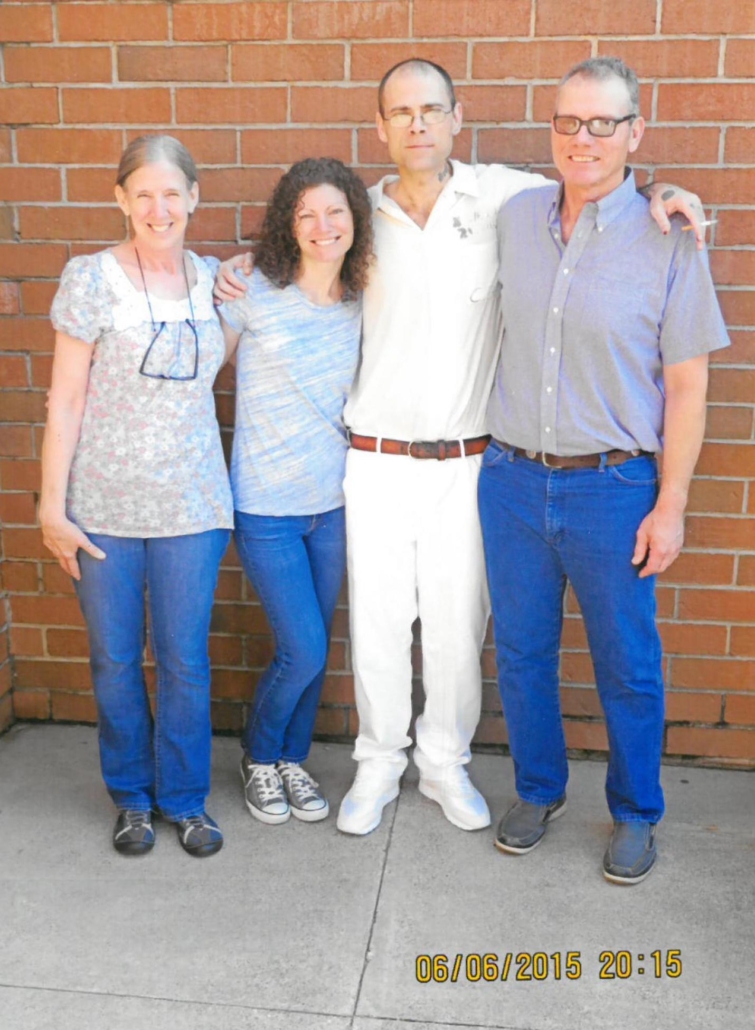

Brian Rigsby with his family (l to r) mom Pamela Moser, sister Elizabeth Neely, and dad Mitchell Rigsby (photo courtesy of Pamela Moser)

Pamela Moser sat in front of the Alabama Board of Pardons and Paroles in late August and waited for her son’s case to come up for consideration. Release was Brian Rigsby’s best chance at escaping the violence that earlier in the month left him with multiple stab wounds and lacerations that weren’t properly treated, his mother, who is a nurse, told Appleseed. 

But before Mr. Rigsby’s name was called, Ms. Moser, 67, and her son’s father, Mitchell Rigsby, 68, who came for the hearing, were told that a mistake had occurred and her son would not have a parole hearing that day. It will likely be five years before their son gets a chance for an early release. 

For Brian Rigsby, that means five more years in treacherous prisons with easy access to the kinds of drugs that got him there to begin with, but little access to rehabilitation or mental health care that might help him earn parole. Or at least avoid more brutality. It’s a seemingly endless cycle of hopelessness experienced by thousands whose convictions stem from substance use, mental illness or a combination. 

Mr. Rigsby, 46, had been turned down at a hearing on July 13, when the only two board members on what is supposed to be a three-member board voted against releasing him under parole supervision. Those two members disagreed on when to reset his next hearing, with one voting to set it off for three years and the other for five years. In the days following that hearing, however, Mr. Rigsby told his mother he’d received a letter from the Alabama Bureau of Pardons and Paroles telling him they’d set him for another hearing on Aug. 31. Everyone got their hopes up. 

Brian Rigsby (photo courtesy of Pamela Moser)

“He was so excited about that letter, because it said they were going to reconsider,” Ms. Moser said. She worried that once she had to tell him the hearing never took place his mental health could decline further. She described the incident as “infuriating.” 

A Bureau attorney explained to Appleseed that when just two board members vote to deny parole, the next question before them is how long into the future to set the next hearing. If both members can’t decide, according to the Bureau’s rules, the date is automatically set at the maximum, which is five years. Since Mr. Rigsby’s parole hearing in July, a third board member was appointed, but through July the Board was on track this year to release the smallest percentage of eligible prisoners on parole in over a decade, according to Alabama Daily News, “granting parole to just 7.5% of the 2,332 prisoners eligible for release as of Thursday.” 

There is good reason for Ms. Moser to want her son out of Alabama prisons. After that July parole denial, Mr. Rigsby was attacked at Bullock Correctional Facility by two men in a dispute over drugs, Ms. Moser said her son told her. He was beaten in the head with a broom handle and stabbed several times before a correctional officer intervened, she said. Mr. Rigsby has served nearly two decades in Alabama prisons with mental illnesses diagnosed not long before the crime for which he was convicted. 

At a prison visit in August, his mother said she saw five wounds of between a quarter of an inch to a half inch long on his head, and while some had sutures she said “one was gaped open,” as were stab wounds on his calves. Just as concerning was his apparent mental state. During the visit her son dumped his food from his plate and ate it from the table “like a caged animal,” Ms. Moser said. 

The Alabama Department of Corrections (ADOC) in a response to Appleseed’s questions about the attack said that Mr. Rigsby was taken to a local hospital on Aug. 23 after an apparent assault and that “a suspect has not been identified by Rigsby.” He was returned to Bullock prison on Aug. 26, the mother said. The warden told her that in addition to the stab wounds her son had fractured ribs and a facial fracture. Mr. Rigsby told his mother in a Sept 7 phone call from prison that the doctor who treated him said he also had two small skull fractures. 
Brian with his sister Elizabeth (photo courtesy of Pamela Moser)

Her son declined to tell prison staff who attacked him over fear that doing so could place him in greater jeopardy, Ms. Moser said. “He’s afraid that if he reports them, even though they say they’ll protect him, you don’t know that that’s going to happen,” she said. She talked to her son after his return to Bullock prison and said he seemed very distraught and just kept saying “I love you.”

Speaking to the prison’s warden on Sept. 4, Ms. Moser said she was told that her son would be moved to another prison because “they can’t figure out who did this to him.” The next day Mr. Rigsby was moved to Elmore Correctional Facility, according to ADOC records. 

Mr. Rigsby is serving a life with parole sentence after pleading guilty in 2007 to first degree robbery in which no one was physically harmed, court records show. In 2003 at the age of 27 Mr. Rigsby robbed a pharmacy in Walker County, according to court records, and stole $315 and more than 1,000 combined oxycontin, methadone and oxycodone pills. Mr. Rigsby had four prior felony convictions – three burglary convictions and one conviction of possession of a forged instrument. 

Drugs have consumed much of their son’s adult life, his parents explained, and now Mr. Rigsby finds himself in Alabama prisons, where instead of effective drug treatment that might prevent his return to prison, he’s surrounded by drugs at every turn, drugs that are most often brought in by correctional officers and prison staff. Those drugs are also driving much of the violence and death. 

The federal government in December 2020, sued the state and the Department of Corrections alleging that the state “fails to provide adequate protection from prisoner-on-prisoner violence and prisoner-on-prisoner sexual abuse, fails to provide safe and sanitary conditions, and subjects prisoners to excessive force at the hands of prison staff.” 

In a May 2021 amended complaint in the ongoing litigation, the DOJ makes clear that ADOC has fallen short in addressing the primary contributor to the unconstitutional violence: contraband. (“ADOC told us that ADOC staff are bringing illegal contraband into Alabama’s prisons,” a 2019 report by the DOJ noted.) 

The DOJ notes in the complaint that drugs and “the inability to pay drug debts leads to beatings, kidnappings, stabbings, sexual abuse, and homicides.”  

While there have been several recent arrests of ADOC correctional officers charged in connection with contraband, drugs still remain plentiful in prisons, incarcerated people tell Appleseed.
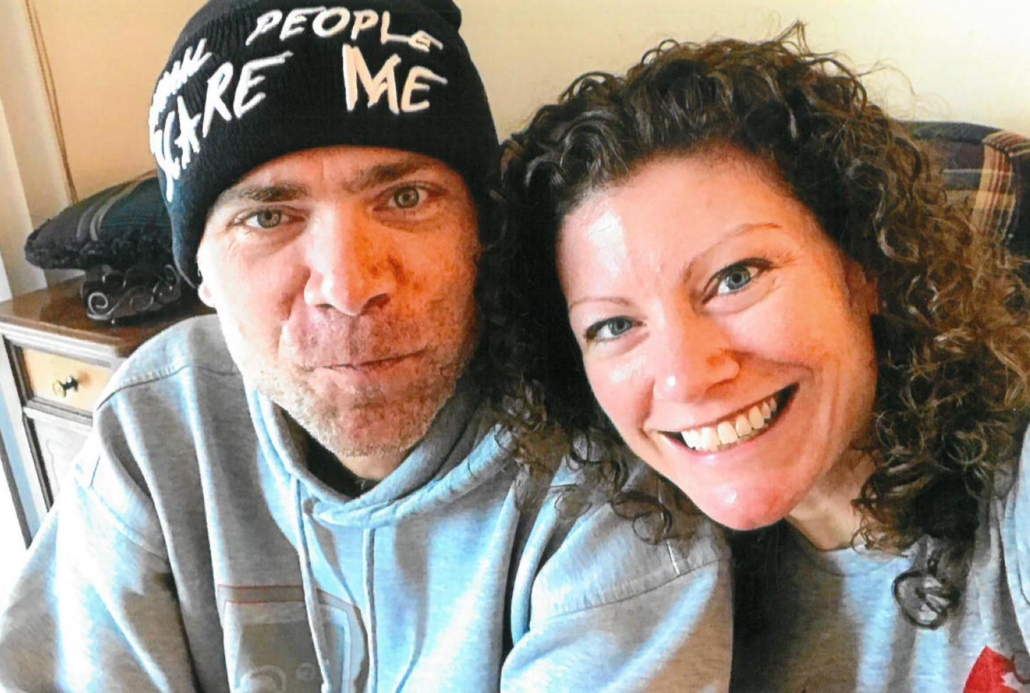
Brian with his sister Elizabeth when he was paroled in 2017 (photo courtesy of Pamela Moser)

Mr. Rigsby was released on parole in 2017, and was sent back to prison to serve that life with the possibility of parole sentence the following year, not because of a new criminal charge but because of a technical parole violation. 

Just prior to the pharmacy robbery Mr. Rigsby was diagnosed with bi-polar disorder, psychotic disorder, opiate/polysubstance dependence and suicidal ideation and attempts, his attorney wrote in a court filing prior to his conviction. The attorney wrote that he was hospitalized at the South Lake Center for Mental Health in Merrillville, Indiana for a suicide attempt “where he stabbed himself in the neck with a paring knife.” 

Ms. Moser said the doctor in Indiana told her the psychotic break could have been from coming off Methadone too quickly, and that a diagnosis of bipolar disorder can’t be discerned from one incident, but that the suicide attempt was “very intentional” and required exploratory surgery on his neck. 

Alabama’s failure to properly treat and keep safe from harm those incarcerated people with mental illnesses is the centerpiece of a long-running lawsuit that seeks to force ADOC to make corrections. 

The federal judge in the 2014 Braggs v. Dunn lawsuit said in 2017 that Alabama’s treatment of mentally ill prisoners was “horrendously inadequate” and that prisons were woefully understaffed, which exacerbated the mistreatment. 

“Prisoners do not receive adequate treatment and out-of-cell time because of insufficient security staff,” Judge Myron H. Thompson of the U.S. District Court for the Middle District of Alabama said in a 2021 order. “They are robbed of opportunities for confidential counseling sessions because there are too few staff to escort them to treatment, forcing providers to hold sessions cell-side. They decompensate, unmonitored, in restrictive housing units, and they are left to fend for themselves in the culture of violence, easy access to drugs, and extortion that has taken root in [DOC] facilities in the absence of an adequate security presence. The resulting sky-high rates of suicidality divert scarce mental-health resources from treatment provision to crisis management, exacerbating the deficiencies in care.”

Suicides, and suicide attempts,  among those with mental illnesses is all too common  in Alabama’s prisons, Thompson has noted in his orders.  In “light of the significant number of wholly unanticipated suicides in ADOC segregation units, by individuals who were not on the mental-health caseload, defendants’ contention that ‘the system works’ is astonishing,” Thompson wrote in a 2019 opinion

Brian with his mom Pamela when he was paroled in 2017 (photo courtesy of Pamela Moser)

As for Mr. Rigsby, he has not received any treatment for mental illness while in custody of the state, his mother said. 

“The robbery happened soon after he came back to Alabama, and I have often thought Brian didn’t plan on coming out of that drugstore alive. Once he got in the system, there was no follow up, as far as I know, about evaluating his possible/probable bipolar diagnosis,” Ms. Moser said. 

Last year, Alabama prisons saw a record 270 deaths, which was nearly 200 percent higher than a decade ago. Between January and June, the last period in which ADOC has released numbers, there have been 164 deaths in state prisons. If that pace keeps up, 2023 will be another record year of prison deaths in Alabama. 

Ms. Moser worries that even if her son survives and is some day released, he may come out a different person. 

“The longer they stay in there, the less chance that they’re going to be able to function in society,” she said.

As victim’s rights week draws to a close, we would like to share a bit more about why we published Afterward, who we are, and what we hope will come next.

By Leah Nelson, Research Director


Alabama Appleseed has built a reputation for thoughtfully elevating issues at the intersection of poverty, racism, and mass incarceration in Alabama. That intersection is fertile ground, and no single group could tackle every issue that it includes. For the last five years, we have mostly focused on issues impacting people who are accused or convicted of crimes: fines and fees, drug policy, Alabama’s Habitual Felony Offender Act, and the state’s brutal prisons.

Like mass incarceration and the criminalization of poverty, violent victimization also lives at the intersection of poverty, racism, and mass incarceration in Alabama. As we developed deeper relationships, we heard more and more about times the people we were talking with had experienced violent victimization within their communities. We heard from people who were frustrated at being pulled over repeatedly for things like busted headlights, but who also wondered why police couldn’t prevent the seemingly endless cycle of shootings and retaliatory violence in their neighborhoods. We heard from people who were relieved when the people who harmed them or killed their loved ones were arrested or convicted, but who also felt appalled at the lengthy sentences, including capital punishment, that had been imposed. 

There is no conflict in caring about the people who are harmed by mass incarceration in Alabama and also caring about the people who are harmed by crime in Alabama. As we have learned in our years documenting the experiences of marginalized communities in Alabama as they interact with the justice system, they are very often the same people. 

Afterward is an attempt to chronicle that reality, to demonstrate that our lives and communities are more complicated than the reductive narratives so often handed to us, and to delve into the ways we are all shaped by the hard parts. 

Why us?

The Appleseed staffers and consultants who contributed to this report include people impacted by many of the harms we document here. Among us are formerly incarcerated people; people who have experienced violent victimization, sexual violence, and the loss of loved ones to homicide and incarceration; people who live with serious mental health challenges; and people who live or have lived in communities with high levels of violence. 

Some of us live and always have lived very privileged lives; others, not so much. We are all Alabamians by birth or by choice. And we all want to see this complicated place we call home thrive.  

We are grateful to all the people who shared their personal stories with us as we traveled the state to develop this report.

What next?

Afterward is not a report about crime and punishment, but about what happens after people have experiences that are unmanageable. How they carry on in the wake of trauma and loss. What they do with themselves and to themselves—and with and to their communities—in the aftermath.

We hope Afterward goes toward creating space for everyone we spoke to across Alabama who needs it and forms the basis of a nuanced conversation about how we can build a more inclusive response to what happens after violence occurs. 

By Eddie Burkhalter, Appleseed Researcher 

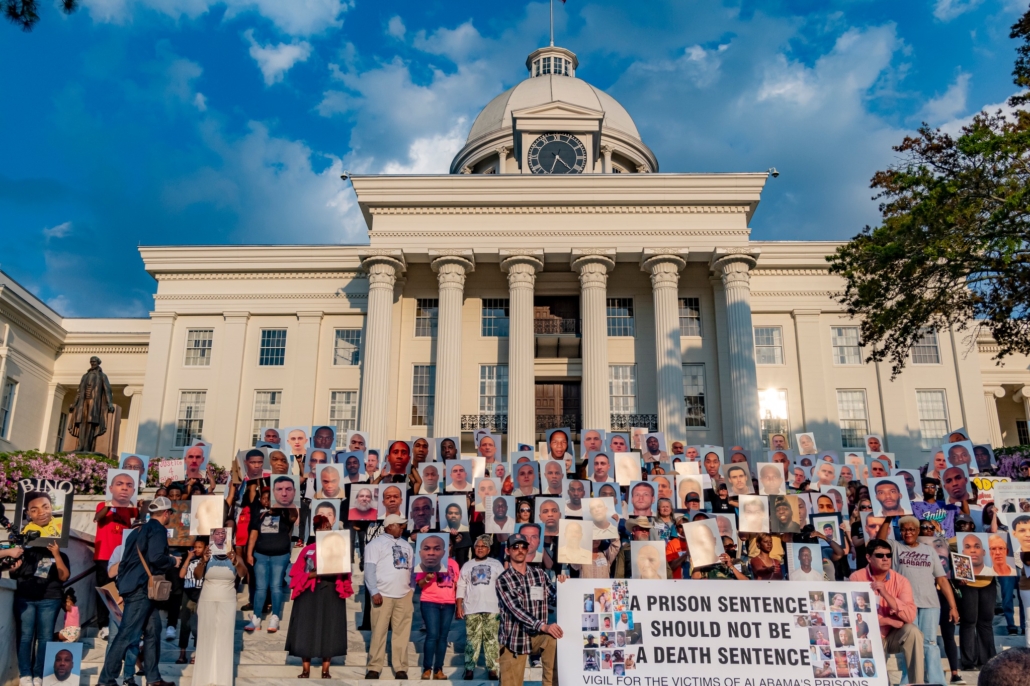
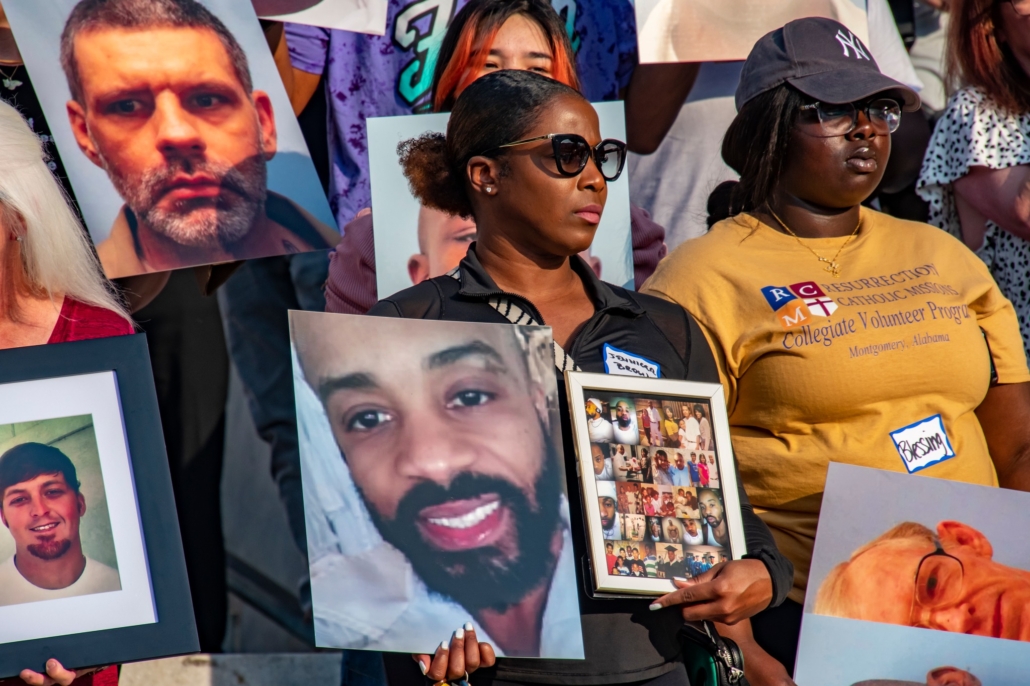
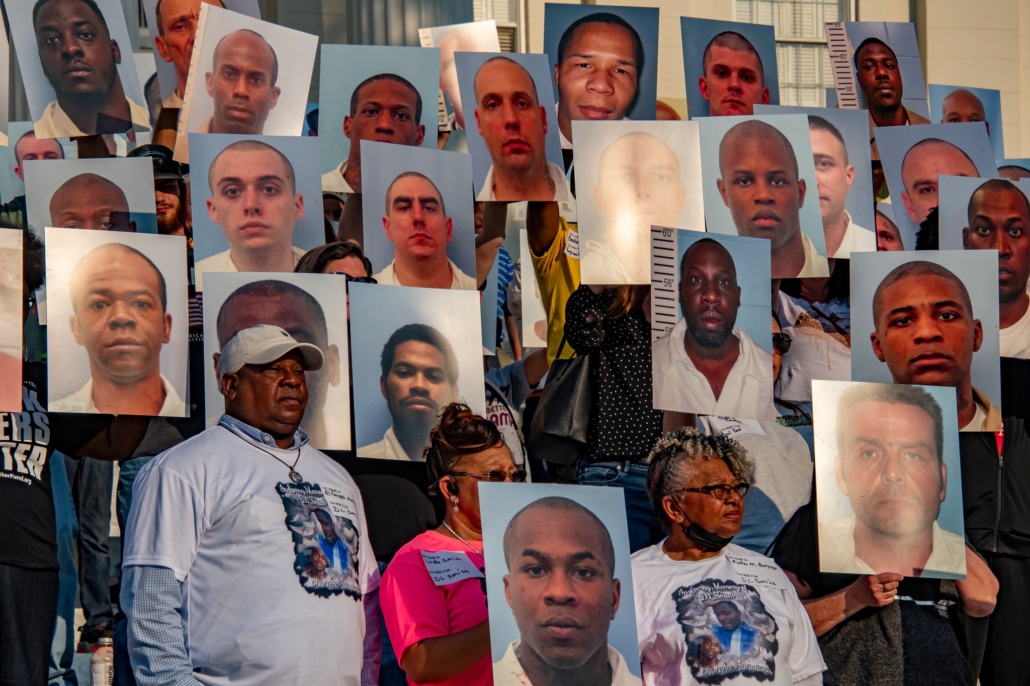
Loved ones stand in front of the State Capitol in Montgomery on March 7, 2023 for a vigil in remembrance of the nearly 300 people who have died in Alabama’s prisons this past year while Gov. Kay Ivey gave her State of the State speech. Photo by Lee Hedgepeth

Alabama prison deaths are again surging, after state prisons saw a record high year of deaths in 2022. 

At least eight men have died in Alabama prisons this month, following 12 deaths in February and 12 in January, although the actual numbers are likely higher. Those 32 deaths include three homicides, numerous suspected drug overdoses, deaths likely caused by illnesses and one suspected suicide. 

The Alabama Department of Corrections (ADOC) doesn’t release timely reports on prison deaths, leaving it up to journalists and others to receive tips and seek confirmation. With prisons woefully overpopulated and understaffed, despite a court order to increase the number of correctional officers, the State has failed to keep incarcerated people safe from deadly drugs and violence..

Appleseed confirmed that from the start of 2022 through Dec. 28 there were 266 deaths in Alabama prisons. The Montgomery Advertiser confirmed four additional deaths between Dec. 28 and the end of the year, bringing the total to 270 last year. 

Loved ones hold pictures of those who have died in Alabama’s prisons. Photo by Lee Hedgepeth

Of the 270 Alabama prison deaths, at least 95 were preventable: homicides, suicides, and confirmed or suspected drug-related deaths, according to investigative reporter Beth Shelburne. This is the highest number of preventable deaths since she began tracking them in 2018.

There is no evidence suggesting that ADOC investigations, interventions, or the plans to build new prisons are stemming the loss of life. In fact, as the Legislature has poured increasing amounts of tax dollars into the prison system, conditions have only gotten more brutal. Currently, ADOC costs Alabama taxpayers around $3 billion: $1.3 billion for new prisons, $1.06 billion for a healthcare contract, about $700 million in annual General Fund dollars.

Most recently, Steve Cliff, 57, on Tuesday was found unresponsive at Staton Correctional Facility and was pronounced dead, ADOC confirmed for Appleseed. 

Felix Ortega, 39, died on March 7 at Elmore Correctional Facility after being assaulted by several other incarcerated people, according to the Equal Justice Initiative. ADOC in a response on March 14 wrote that “There has been no report of an assault on inmate Felix Ortega.” 

Tony Evans, 51, was found unresponsive at Donaldson Correctional Facility on March 5 and was pronounced dead that day in the health care unit, the Alabama Department of Corrections confirmed for Appleseed. 

Joshua Ledlow, 39, was found unresponsive and died at Limestone Correctional Facility on March 2, ADOC confirmed. Sources tell Appleseed his death is suspected to be caused by an overdose. Ledlow was serving a 15 year sentence after pleading guilty in 2017 to a charge of burglary in Cullman County, according to court records. 

A day after Ledlow’s death, 33-year old Mohamad Osman was found unresponsive at Limestone prison and was pronounced dead, ADOC confirmed. Sources tell Applseed his death was also likely the result of an overdose. 

Bunyan Goodwin, Jr., 51, told prison staff on March 4 that was having trouble breathing, ADOC confirmed for Appleseed. 

“He was transported to the Health Care Unit for evaluation and treatment. His condition deteriorated and he became unresponsive,” a department spokesperson wrote to Appleseed. “Life-saving measures were administered, but medical staff was unable to resuscitate him, and he was pronounced deceased by the attending physician.”

That same day, Bobby Ray Bradley, 69, died at Donaldson Correctional Facility, as did 40-year-old Joshua Strickland. Bradley’s death followed a long illness, according to the Jefferson County Coroner’s office. Strickland was found unresponsive in his cell and was pronounced dead at the prison’s health care unit, according to ADOC. 

According to several sources who spoke to Appleseed, Michael Hubbard, 46, was beaten by another incarcerated person at St. Clair Correctional Facility days before he died on Feb. 22 at a local hospital.

The ADOC spokesperson wrote that Hubbard’s death was reported but gave no information about how he may have died. In a photo obtained by Appleseed, Hubbard appears to be in physical distress, lying under a bed. The incarcerated man who supplied that photo said it was taken after Hubbard was beaten. 

Appleseed asked in a followup request whether he had been assaulted prior to his death, and the spokesperson responded “ADOC can’t comment on open investigations.”

The Vigil for Victim’s on March 7, 2023. Photo by Lee Hedgepeth

Appleseed replied that the department regularly states in press releases when a person dies as the result of an assault, and sent the photo of Hubbard to the department. 

In a followup response five days later the spokesperson wrote to Appleseed that “there has been no report of an assault on inmate Michael James Hubbard” and that he was taken to the prisons health care unit “for evaluation and treatment due to a suspected overdose.”

“During transport, he stopped breathing. Life-saving measures were administered, and he was stabilized. He was transported to an area hospital for further treatment. Unfortunately, his condition never improved and ultimately, he died,” the response continued. 

Brian Keith Wanner, 47, died at Bullock Correctional Facility on Feb, 4 after being assaulted by another incarcerated person two days before, according to ADOC. 

Family members honor their loved ones who died in Alabama’s prisons this past year. Photo by Lee Hedgepeth

Families across Alabama whose loved ones have died in state custody are trying to get the attention of elected officials, but have largely been ignored. On March 7, the first day of the 2023 legislative session, about 100 Alabamians gathered at the Alabama State Capitol for a vigil in honor of those who died in state prisons in recent years.

Below is a list of the incarcerated people who have died in state custody so far this year:

January deaths

  • Carl Kennedy, 57, died at Limestone Correctional Facility on Jan. 2 after being found “in distress,” according to ADOC.
  • Ariene Kimbrough, 35, died at Limestone Correctional Facility on Jan. 4 after being assaulted by another incarcerated man, according to ADOC.
  • Paul Rolan Ritch, Jr, 53, died at Staton Correctional Facility on Jan 6, according to Alabama Political Reporter.
  • Kevin Marcus Ritter, 33, died at Donaldson Correctional Facility on Jan. 7 after being found unresponsive, according to ADOC.
  • Ronald Nowicki, 66, died at Limestone Correctional Facility on Jan. 10 after being found unresponsive, according to ADOC.
  • Corey Jerome Johnson, 49, died at St. Clair Correctional Facility on Jan. 11 in a suspected suicide, according to Alabama Political Reporter.
  • Trenton Jamario White, 30, was found unresponsive and died at Donaldson Correctional Facility on Jan. 28, according to ADOC.
  • Justin Douglas Grubis, 25, was found unresponsive at Ventress Correctional facility on Jan. 28 and was pronounced dead, according to ADOC.
  • Michael Theodore Medders, 61, was found unresponsive and died at Donaldson Correctional Facility on Jan. 29, according to ADOC.
  • Christopher Shannon Fulmer, 44, died Jan. 31 at Elmore Correctional Facility after being found “in physical distress,” according to ADOC. Fulmer’s mother in April told the Alabama Board of Pardons and Paroles that her son would die in prison if they denied him parole.
  • Roderick Demarcus Lee, 33, died at Kilby Correctional Facility on Jan. 27 after the department said he was found “behaving erratically in his dorm.”

February deaths

  • Brian Wanner, 57, died at Bullock Correctional Facility on Feb. 4 after being assaulted by another incarcerated man, according to ADOC.
  • Alfred Lee Williams, 57, died at Staton Correctional Facility on Feb. 4 after being found unresponsive, according to ADOC.
  • Craig Randall Lee, 67, died at Staton Correctional Facility on Feb. 5 after being found unresponsive, according to ADOC.
  • Timothy Sanderson, 57, was pronounced dead at St. Clair Correctional Facility on Feb. 5 after being found in his dorm’s shower, according to ADOC.
  • Michael Wayne Perry, 62, died at Donaldson Correctional Facility on Feb. 8 after being found unresponsive, according to the Jefferson County Coroner’s Office.
  • Larry Dewayne Dill, 44, died at Fountain Correctional Facility on Feb. 13 after reporting chest pains to prison staff, according to ADOC.
  • Reginald Rashard Davis, 41, died at Staton Correctional Facility on Feb. 15 after experiencing “respiratory issues,” according to ADOC.
  • Michael James Hubbard, 46, died at St. Clair Correctional Facility on Feb. 22. Sources tell Appleseed he was assaulted by another incarcerated man days before he died. ADOC says his death is a suspected overdose.
  • Michael Joe White, 45, was found unresponsive at St. Clair Correctional Facility on Feb. 22 and died that day, according to ADOC.
  • Christopher Melton, 37, died at Ventress Correctional Facility on Feb. 22 after being attacked by another incarcerated man, according to ADOC.
  • C. Borden, Jr, 55, was found unresponsive and was pronounced dead at St. Clair Correctional Facility on Feb. 25, according to ADOC.
  • Fredrick Bishop, 55, died at Easterling Correctional Facility on Feb. 27 after being found unresponsive, according to ADOC.
  • Charles Daniel Waltman, 41, died at Easterling Correctional Facility on Feb. 27 after being found unresponsive, according to ADOC.

March deaths 

  • Joshua Felton Ledlow, 39, died at Limestone Correctional Facility on March 2. Sources tell Appleseed his death is a suspected overdose. ADOC says he was found unresponsive.
  • Mohamad Osman, 33, died at Limestone Correctional Facility on March 3 of a suspected overdose, sources tell Appleseed.
  • Bobby Ray Bradley, 69, died at Donaldson Correctional Facility on March 4 and was being treated for multiple medical problems, according to the Jefferson County Coroner’s Office.
  • Joshua Strickland, 40, died at Bullock Correctional Facility on March 4 after being found unresponsive, according to ADOC.
  • Bunyan Goodwin, Jr, 51, died at Bibb County Correctional Facility on March 4 after reporting trouble breathing, according to ADOC.
  • Tony Edward Evans, 51, died at Donaldson Correctional Facility on March 5 after being found unresponsive, according to ADOC.
  • Felix Ortega, 39, died on March 7 at Elmore Correctional Facility after being assaulted by several other incarcerated people, according to the Equal Justice Initiative.
  • Steve Cliff, 57, on March 14 was found unresponsive at Staton Correctional Facility and was pronounced dead, ADOC confirmed for Appleseed.

By Eddie Burkhalter, Appleseed Researcher


Politicians across Alabama expressed concern and outrage when victims were not notified in advance of planned releases of several hundred people from Alabama Department of Corrections custody last week.

Those notifications didn’t happen because of underfunded, troubled victim notification systems and an unwillingness by an array of state leaders to fix these problems during more than a decade of dysfunction, Appleseed has learned.

These victim-notification shortcomings came to a head last week, upending what was supposed to be the orderly first phase of a supervised release program instituted in 2021 by bipartisan vote as part of a desperately needed effort to relieve crowding and ensure safe re-entry for incarcerated people nearing the end of their sentences.

As release day approached, court filings revealed that, contrary to the written letter of the law, the Alabama Department of Corrections (ADOC) had notified fewer than 20 victims affected by the pending release of approximately 400 incarcerated people, which began last week.

ADOC had more than 15 months since the law passed to notify these victims. What went wrong?

The problem dates back at least a decade and a half, and appears to be crime victim notification systems and departments that don’t share data between several systems and a failure of multiple state actors and agencies to address the problems, despite a law enforcement culture perpetually claiming to put victims first.

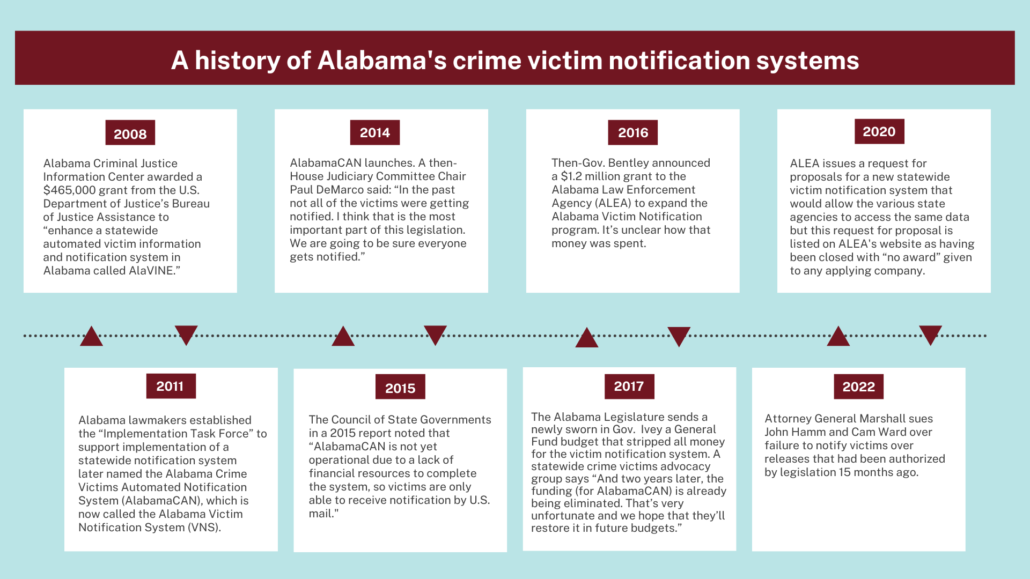
First, in 2008, the Alabama Criminal Justice Information Center was awarded a $465,000 grant from the U.S. Department of Justice’s  Bureau of Justice Assistance to “enhance a statewide automated victim information and notification system in Alabama called AlaVINE.”

AlaVine is still active but appears only to be used by Sheriffs offices in Alabama.

ADOC uses its own stand-alone system that requires users to register online here. An ADOC spokesperson explained to Appleseed that ADOC’s system doesn’t automatically enroll victims. Because of this, many victims don’t receive notifications.

“If people don’t register, we don’t have their information,” the spokesperson said.

To complicate matters, the Alabama Attorney General’s office and the Alabama Bureau of Pardons and Parole use a separate notification system called the Alabama Victims Notification System, formerly called AlabamaCAN, but historically data from that system hasn’t been shared with ADOC.

Alabama Bureau of Pardons and Paroles Director Cam Ward told Alabama Political Reporter last week that the notification problem at ADOC may be because of ADOC’s notification system.

“The problem is that they don’t have access to the same database that we have,” Ward told APR, adding that this separation was enforced by law. “We need a new notification system.”

The ADOC spokesperson told Appleseed that the department started working with the AG’s office to gather victim information for the necessary notification of those being released under the 2021 law. Asked whether ADOC’s work with the AG’s office to obtain that victim information began last week, the spokesperson declined to directly answer, and wrote that “ADOC, ABPP, and the AG’s office are working together to ensure these notifications.”

Yet another attempt to solidify a uniform database came in 2011. That’s when Alabama lawmakers through the Alabama Act 2011-681 and Code 15-22-36.2 established the “Implementation Task Force”  to support implementation of a statewide notification system that was later named the Alabama Crime Victims Automated Notification System, or AlabamaCAN, which is now called the Alabama Victim Notification System and is known as VNS.

The code also established the “Victim Notification System Fund in the State Treasury” to be paid out by the Alabama Law Enforcement Agency (ALEA) at the direction of the task force.

The task force was to meet first on March 1, 2012, and once members voted that a system complied with requirements in Alabama codes, the task force was to “automatically convert to the Victim Notification Oversight Council…”

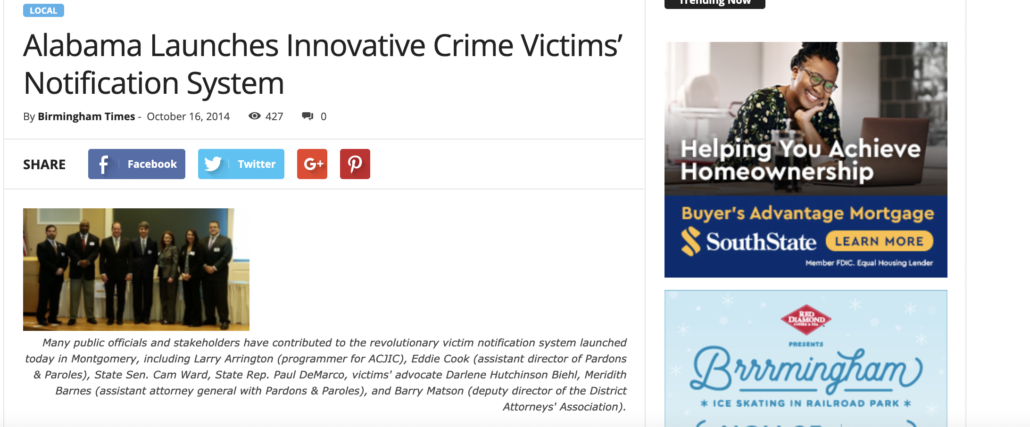
Press coverage in October 2014 lauded an “innovative” crime victim notification system. Appleseed has learned of over a decade of underfunding and an unwillingness by an array of state leaders to fix the troubled victim notification systems.


AlabamaCAN launched in October 2014 and was supposed to allow victims to be notified of parole hearings “via email, text message or automated phone call.”

Press coverage lauded the “innovative” crime victim notification system and featured photos that included then-State Rep. Paul DeMarco and victims advocates as part of a task force implementing the new system. At the time, then-House Judiciary Committee Chair Paul DeMarco was quoted by WBRC as saying: “In the past not all of the victims were getting notified. I think that is the most important part of this legislation. We are going to be sure everyone gets notified.”

DeMarco recently weighed in on the early releases, but made no mention of this system.

From the very start AlabamaCAN was troubled, not in small part due to a lack of funding and coordination.

The Council of State Governments in a 2015 report noted that “Alabama’s automated victim notification system is not operational and not all victims are notified when people are released from prison to the community.”

“AlabamaCAN is not yet operational due to a lack of financial resources to complete the system, so victims are only able to receive notification by U.S. mail,” researchers wrote in the 2015 report. “Currently, not all victims are notified when an offender is released from prison. There are gaps in the DOC notification process, such as victims not always being notified if the offender is released from prison for medical treatment or is released to a CCP work release program.”

More attempts to fix the issues came along in 2016.

Then-Gov. Bentley announced a $1.2 million grant to ALEA to expand the Alabama Victim Notification program. It’s unclear how that money was spent: an ALEA spokeswoman received Appleseed’s questions regarding that grant, but did not provide responses as of the publishing of this piece.

Suddenly, a year later, after Gov. Kay Ivey was first sworn into office in 2017, the Alabama Legislature sent Ivey a General Fund budget that stripped all money for the victim notification system.

“This was something that was promised to victims two years ago when they were wanting to release more inmates from prison to help us take the notification system to a new level,” then-president of a chapter of a statewide crime victims advocacy group told WSFA 12. “And two years later, the funding is already being eliminated. That’s very unfortunate and we hope that they’ll restore it in future budgets.”

On Feb. 21, 2020, ALEA issued a request for proposal for a new statewide victim notification system that would allow the various state agencies to access the same data.

Proposals were to be submitted by April 6, 2020, and the system was to be designed to “integrate with the Alabama Board of Pardons and Paroles (“ABPP”), the Alabama Department of Corrections (“ADOC”), and other state agencies as may be needed” but this request for proposal is listed on ALEA”s website as having been closed with “no award” given to any applying company.

ALEA has not since issued a similar request for proposal for a new notification system, according to the agency’s website.

While crime victims were left wondering whether Alabama’s leaders are serious about following through on their promises to put victims first, people incarcerated in Alabama’s violent, deadly prisons were subject to yet another failure at the hands of the agency that incarcerates them.

The notification problems have left those expecting to be released under the 2021 law living in limbo, and even some those who have been released were given only a bus ticket and ankle monitor.

A source within an Alabama prison told Appleseed that violence and fights had increased in the wake of the botched release. And an incarcerated person at Easterling Correctional Facility told Alabama Political Reporter last week that “some of those eligible for the early release had begun giving away food and hygiene items, only to be told they would not be released on Tuesday.”

By Eddie Burkhalter, Appleseed Researcher


A recent report by the nonpartisan, nonprofit Council of State Governments (CSG) found that overall crime, including violent crime, across the U.S. and in Alabama, has been on the decline.

The report’s findings undercut the pervasive narrative of surging crime used to frighten communities and support mass incarceration. But as CSG’s data shows, as prison populations have declined, so has crime.

The CSG report, which used crime data reported to the Federal Bureau of Investigation, also supports Alabama appleseed’s own research that showed overall crime is decreasing.

Appleseed is committed to educating policymakers as to the importance of using research, data, and evidence-based practices to tackle Alabama’s toughest challenges. As we head into the 2023 legislative session, we will continue to lift up nonpartisan research, such as this, to help craft informed decisions about public safety.

The CSG report notes that the violent crime rate between 2019 and 2021 fell in 25 states and increased in just four. Additionally, law enforcement agencies in 21 states failed to report sufficient crime data to the FBI to draw a conclusion on crime rates in 2021.

In states that didn’t report enough data to make a determination on changes in crime through 2021, researchers for the report looked at data through 2020.

In Alabama, which is among the 21 states with insufficient 2021 data, the overall violent crime rate between 2019 and 2020 fell by 12 percent, according to the report. Aggravated assaults dropped by 6 percent and robberies by 33 percent. Rapes fell by 32 percent while homicides increased by 12 percent. Gun violence remains concerning in several Alabama cities, but there is no evidence that fear of long prison sentences or harsh punishment is stemming the problem. Alabama has some of the nation’s harshest sentences, including the death penalty, yet gun violence persists.

The decrease in overall crime is mirrored in the decrease of incarcerated Alabamians, and a drop in the number of people serving prison sentences for violent crimes, according to the report.

In Alabama, “There were 15,189 people in prison for violent offenses at the end of 2020, comprising 60 percent of the total prison population,” the report reads. “Since 2010, the number of people in prison for violent offenses decreased by 10 percent. During that same period, the number of people in prison for nonviolent offenses decreased by 32 percent.”

Just 52 percent of law enforcement agencies reported their full data to the FBI’s National Incident-Based Reporting System for 2021, which the bureau had used alongside the older Uniform Crime Reporting Program until changing fully over to the new system last year.

Among Alabama’s agencies that did not report 2021 data are some of the largest, including the Huntsville Police Department, which covers a jurisdiction of 202,884 people, and the Montgomery Police Department, which covers a jurisdiction of 197,755 residents.

Additional, Alabama-specific crime data can be found at crime.alabama.gov, a collaboration between the Alabama Law Enforcement Agency (ALEA) and the University of Alabama’s Culverhouse College of Business, Institute of Data and Analytics. The website documents the steady decline in Alabama crime from 2005 to 2019 (the most recent year a full data set is available.)